 |
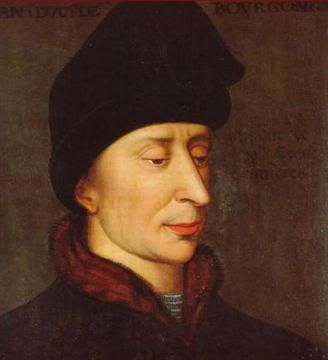
| Jean II of Burgundy |
(1371-1419)
John the Fearless's bastards of Burgundy.
"In all this, the differences between Philip the Bold and John the Fearless seem to be differences of degree only, a fact which is true also of the love life of these dukes. Philip the Bold as a young man seems to have indulged in sexual adventures which he afterwards eschewed, for it is said that the proprietor of the Stag Inn at Hall, where he died, was an illegitimate son of his, born about 1360. But John the Fearless was of a more amorous or wanton disposition. . . This propensity, or weakness, seems to have been transferred to his children, especially Philip the Good. John, bastard of Burgundy, provost of St. Donatian's at Bruges and of St. Peter's at Lille, bishop of Cambrai and archbishop of Trier, who once celebrated mass at Cambrai attended by thirty-six of his illegitimate sons and grandsons, was the bastard son of John the Fearless and Agnes de Croy, whom he had seduced at a dance. John is credited with other illegitimate children, three of them by Marguerite van Borsselen, and among his mistresses was supposed to have been the lady of Giac, Jehanne du Peschin, who was closely involved in the events which led to his assassination." (John the Fearless: The Growth of Burgundian Power, Vol 2: 236)
His lovers were:
1) Agnes de Croy.
Natural offspring:
1. Jean de Bourgogne (d.1479)
Bishop of Cambrai
Jean the Fearless, Duc de Bourgogne, and had an illegitimate child with him, who would become the future Prince-Bishop of Cambrai, 1440-1479, and Archbishop of Trier. (de Remi Beaumanoir: 56)
" . . . For John of Burgundy, himself a bastard of John the Fearless, a requiem mass was celebrated in Cambrai in 1480, by the 36 illegitimate children and grandchildren; one more detail: John of Burgundy had been bishop of Cambrai. . . . " (Acta Historiae Neerlandicae: Studies on the History of the Netherlands VII: 5-6)
2) Elisabeth von Immerseele.
3) Gudula Bonne van Goede von Duershyn.
4) Jeanne de Spontin.
5) Jehanne du Peschin
Lady of Giac.
(suspected as a mistress)
"On the Burgundian side, scapegoats for the death of John the Fearless were soon found. Two people in particular, both of whom fell into the hands of the Dauphinists at Montereau and thereafter joined the dauphin's party, came in for obloquy. They were accused of treachery and high treason, and have ever since been under suspicion of complicity in the crime. I refer to the lady of Giax and Philippe Jossequin. Who was the lady of Giac, later reputed to have been the mistress of John the Fearless? Petit suggested Catherine, the wife of a ducal chamberlain, Pierre de Giac, who was related by marriage to the count of Tonnerre, enemy of John the Fearless. But contemporary documents make it plain that the lady of Giac in question, who certainly was a favourite of John the Fearless and recipient of many generous gifts from him, was Jeanne du Peschin, the mother, not the wife, of Pierre de Giac. Whether she was also the recipient of John's amatory advances seems doubtful in view of the fact that she must have been at least fifty at the time, having married Louis de Giac in 1376. All accounts agree that Jehanne de Giac had urged John the fearless to go to Montereau, assured him of Charles's pacific intentions, and done all she could to achieve a rapproachement between the two. The reason for this behaviour was simple enough: her son Pierre was a chamberlain and knight of John the Fearless, while her brother, Jacques du Peschin, was a councillor of the dauphin. There is no evidence whatsoever that either Jehanne or her son Pierre were traitors. At Montereau, Pierre was one of those with Duke John in the enclosure, and his mother was in the castle. They changed sides after their capture by the Dauphinists because, as the chronicler le Bouvier explained, they feared unpopularity or even persecution among the Burgundians owing to their share in the efforts to bring about a personal meeting between Charles and John. It was this change of sides, immediately after the murder, which led to the rumour that they were accomplices in it." (John the Fearless: 284)
6) Katharina Arents.
7) Katharina van Sweiten.
8) Klara van den Hoede.
9) Lucie Brans.
10) Margareta Absaloens.
11) Margareta van Borsselen.
". . . John the Fearless was of a more amorous or wanton disposition. Mulierosior patre multo fuit, as the sixteenth-century Dutch historian Pontus Heuterus put it. This propensity, or weakness, seems to have been transferred to his children, especially Philip the Good. . . ." (John the Fearless: 236)
Philippe's great wealth.
" . . . Not as large as the Empire, nor as consolidated as the kingdoms of England and France, yet the Valois Duchy of Burgundy rivalled and frequently outshine the power and influence of its neighbours. Philip the Good had died one of the greatest princes of his ear, and certainly the richest. His personal treasure amounted to 400,000 crowns, a huge amount. In size, the Burgundian lands were equivalent to Portugal or England and Wales but they accommodated a much more diverse collection of people, resources and industries. The languages of the duchies ranged from French to German, and the ducal government was conducted in French, Dutch and German. The population was not large when compared with France or England, there were only about two and a half million people in the northern lands between Friesland and Picardy, but the density of population in Flanders and Brabant was the greatest in northern Europe." (Margaret of York: The Diabolical Duchess)
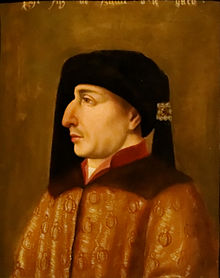
Philippe III of Burgundy
(1396-1467)
Duc de Bourgogne
1419-1467
Husband of:
1. Michelle de Valois, mar 1409
2. Bonne d'Artois, mar 1424
Philippe's great wealth.
" . . . Not as large as the Empire, nor as consolidated as the kingdoms of England and France, yet the Valois Duchy of Burgundy rivalled and frequently outshine the power and influence of its neighbours. Philip the Good had died one of the greatest princes of his ear, and certainly the richest. His personal treasure amounted to 400,000 crowns, a huge amount. In size, the Burgundian lands were equivalent to Portugal or England and Wales but they accommodated a much more diverse collection of people, resources and industries. The languages of the duchies ranged from French to German, and the ducal government was conducted in French, Dutch and German. The population was not large when compared with France or England, there were only about two and a half million people in the northern lands between Friesland and Picardy, but the density of population in Flanders and Brabant was the greatest in northern Europe." (Margaret of York: The Diabolical Duchess)
Philip the Good's weakness of the flesh.
"Bishop Guillaume Fillastre's flattering portrait of Philip the Good is somewhat marred by his admission that the duke suffered from what the bishop called 'the weakness of the flesh'. But the bishop, who was himself a bastard, son of an abbot and a nun, makes two points in Philip's mitigation. First, that chastity, which is more of an angelic than a human quality, is in any case given only to a few; and, second, that the duke never actually committed rape or violence. It is Olivier de la Marche who tells us that Philip had 'a very fine company of bastards of both sexes---de bastards et de bastardes une moult belle compaignie'. But his wives were notably unsuccessful in bearing him children. This first two, both French princesses, bore him none. Michelle de France died in 1422 when Philip was only twenty-six. Bonne of Artois, whom Philip married in 1424, bore him three sons in 1431-3, but only the third, Charles, survived." (Philip the Good: the Apogee of Burgundy, Vol 3: 132)
Unseen mistresses, but publicly proclaimed bastards.
"Philip's mistresses, however, never appeared publicly, nor can they be shown to have exercised any influence on his government. They were not seen at Court and their names are hardly mentioned by the chroniclers. But for the scrupulous bookkeeping of the Exchequer they wold have fallen into total oblivion. Nevertheless if Isabella, Philip's third wife, the clever and haughty Portuguese princess, was not forced to meet her rivals officially at Court, the Duke's numerous bastards served to remind her constantly of the unhappiness of their married life. These children of illicit intercourse were brought up and maintained in the same way as the legitimate offspring. They bore the ducal coat of arms, the bar sinister along proclaiming their illegitimacy. The daughters appeared at Court festivities, the sons played an illustrious role as generals, diplomats or princes of the Church. La Marche . . . made a collection in his memoirs of the great deeds done by bastards from remotest times; and no one saw any reason for comment and Bishop John, an illegitimate son of Duke John the Fearless, was entrusted with the duty of christening Marie, the daughter of Charles the Bold." (The Court of Burgundy)
Multiple mistresses maintained in different places.
" . . . Unlike many other rulers, Philip altogether excluded his mistresses from state affairs, though he made use of his bastards, in the service of politics and war, more successfully than most. His mistresses by no means followed the normal pattern, of a succession of favourites. Instead, he maintained a number at once, in different places. This was merely a matter of convenience and economy; it is reflected in the surnames given to three of the bastards by a chronicler: Baudouin of Lille, Jehan of Bruges, and Philippe of Brussels. Other mistresses lived at Arras and Louvain. . . ." (Philip the Good: 132)
26 bastards of Philip the Good.
" . . . Philip the Good had at least twenty-six illegitimate children. Many of them exercised high-ranking functions and became the pillars of ducal policy. That is why the Burgundian empire has sometimes been called a 'bastardocracy'. . . ." (Neptune and the Netherlands: State, Economy and the War at Sea in the Renaissance: 98)
Exaggerated number of 26 bastards & 33 mistresses?.
" . . . One cannot pretend that the subject of Philip's mistresses and their progeny has yet been illuminated by historical truth. Instead, their numbers have been exaggerated by the devious enthusiasm of genealogists, behind whose efforts may be discerned the aristocratic aspirations of a number of people alive today, who are proud to bear the surname Bourgogne. A recent genealogical work lists twenty-six bastards of Philip, and thirty-three mistresses; one suspects that the severe pruning of historical scholarship might reduce the numbers to perhaps fifteen and twenty respectively. A near contemporary list, made by Philipe Wielant, gives eleven bastards in all, six boys and five girls. The portraits of two mistresses and several bastards appear in the famous sixteenth-century collection of pen and ink drawings in the Public Library of Arras." (Philip the Good: 133)
Philip the Good's mistresses & illegitimate children.
Multiple mistresses maintained in different places.
" . . . Unlike many other rulers, Philip altogether excluded his mistresses from state affairs, though he made use of his bastards, in the service of politics and war, more successfully than most. His mistresses by no means followed the normal pattern, of a succession of favourites. Instead, he maintained a number at once, in different places. This was merely a matter of convenience and economy; it is reflected in the surnames given to three of the bastards by a chronicler: Baudouin of Lille, Jehan of Bruges, and Philippe of Brussels. Other mistresses lived at Arras and Louvain. . . ." (Philip the Good: 132)
26 bastards of Philip the Good.
" . . . Philip the Good had at least twenty-six illegitimate children. Many of them exercised high-ranking functions and became the pillars of ducal policy. That is why the Burgundian empire has sometimes been called a 'bastardocracy'. . . ." (Neptune and the Netherlands: State, Economy and the War at Sea in the Renaissance: 98)
Exaggerated number of 26 bastards & 33 mistresses?.
" . . . One cannot pretend that the subject of Philip's mistresses and their progeny has yet been illuminated by historical truth. Instead, their numbers have been exaggerated by the devious enthusiasm of genealogists, behind whose efforts may be discerned the aristocratic aspirations of a number of people alive today, who are proud to bear the surname Bourgogne. A recent genealogical work lists twenty-six bastards of Philip, and thirty-three mistresses; one suspects that the severe pruning of historical scholarship might reduce the numbers to perhaps fifteen and twenty respectively. A near contemporary list, made by Philipe Wielant, gives eleven bastards in all, six boys and five girls. The portraits of two mistresses and several bastards appear in the famous sixteenth-century collection of pen and ink drawings in the Public Library of Arras." (Philip the Good: 133)
Philip the Good's mistresses & illegitimate children.
"Philip also had at leat eighteen children by various of his 24 documented mistresses. . . ." (Burgundian Bastards)
" . . . Philip the Good kept 33 mistresses, who gave birth to a least 26 ducal bastards. . . ." (Acta Historiae Neerlandicae: Studies on the History of the Netherlands VII: 5)
Bastards of bastards in Philip the Good's court.
" . . . At court, besides the duke's own bastards, there were other 'bastards of Burgundy', illegitimate children of John the Fearless; and these, among them, Guyot and Philippotte de Bourgogne, have not always been distinguished from Philip's own children. Moreover, there were bastards of bastards too, for Philip's two oldest bastards, Cornille and Anthony, soon had illegitimate offspring of their own, and these were also 'bastards of Burgundy'. Besides these bastards of Burgundy and of Brabant, there were bastards of Luxembourg and of Bavaria, and probably others." (Philip the Good: 133)
Affair's impact on his wife, family & society.
"The morality of other princes of the day was no better, or perhaps was less than his own. It is related of Philippe le Bon, Duke of Burgundy, that his infidelities caused great sorrow and distress of mind to hi wife, for he was accustomed to admit the objects of his low amours to the balls and fetes of the court, without the slightest regard to the feelings of his duchess. In this particular, at least, Charles exhibited more decency; but when the Duchess of Burgundy visited the Queen of France at Chalons in Champagne, the two princesses frequently, it was said, indulged in mutual revelations and complaints of the wrongs that had endured from the unkindness of their husbands. 'They had,' says Olivier de la Marche, 'the same grief and malady, which is called jealousy.'" (Jacques Cœur, the French Argonaut, and His Times: 162)
His lovers were:
" . . . Philip the Good kept 33 mistresses, who gave birth to a least 26 ducal bastards. . . ." (Acta Historiae Neerlandicae: Studies on the History of the Netherlands VII: 5)
Bastards of bastards in Philip the Good's court.
" . . . At court, besides the duke's own bastards, there were other 'bastards of Burgundy', illegitimate children of John the Fearless; and these, among them, Guyot and Philippotte de Bourgogne, have not always been distinguished from Philip's own children. Moreover, there were bastards of bastards too, for Philip's two oldest bastards, Cornille and Anthony, soon had illegitimate offspring of their own, and these were also 'bastards of Burgundy'. Besides these bastards of Burgundy and of Brabant, there were bastards of Luxembourg and of Bavaria, and probably others." (Philip the Good: 133)
Affair's impact on his wife, family & society.
"The morality of other princes of the day was no better, or perhaps was less than his own. It is related of Philippe le Bon, Duke of Burgundy, that his infidelities caused great sorrow and distress of mind to hi wife, for he was accustomed to admit the objects of his low amours to the balls and fetes of the court, without the slightest regard to the feelings of his duchess. In this particular, at least, Charles exhibited more decency; but when the Duchess of Burgundy visited the Queen of France at Chalons in Champagne, the two princesses frequently, it was said, indulged in mutual revelations and complaints of the wrongs that had endured from the unkindness of their husbands. 'They had,' says Olivier de la Marche, 'the same grief and malady, which is called jealousy.'" (Jacques Cœur, the French Argonaut, and His Times: 162)
His lovers were:
1) Catherine de Tiesfries.
Natural offspring:
1. Baudouin de Bourgogne (d.1505)
2) Catherine Legoix.
"Duke Philippe fell in love with Catherine Legoix - ordered "Garin de Brazey to marry the young girl - Catherine became officially his mistress after her husband's death. She left him after their son died - to go in search of the one man she had never forgotten Arnaud de Montsalvy." (Catherine de Montsalvy Lexicon). [Ref1:One Love is Enough]
"Duke Philippe fell in love with Catherine Legoix - ordered "Garin de Brazey to marry the young girl - Catherine became officially his mistress after her husband's death. She left him after their son died - to go in search of the one man she had never forgotten Arnaud de Montsalvy." (Catherine de Montsalvy Lexicon). [Ref1:One Love is Enough]
3) Catherine Schaers.
Natural offspring:
a. Corneille de Bourgogne, Seigneur de Beures (1420-1452)
Captain-General of Luxembourg; Governor of Luxembourg
4) Celine de Harlay.
5) Isabelle de la Vigne.
Natural offspring:
Natural offspring:
a. Marguerite de Bourgogne (d.1454)
" . . . Isabel de la Vigne received money towards the purchase of a house at Louvain; she also enjoyed a small pension, which the accounting officials were loth to pay, declaring that they had no idea why the duke had given this woman a pension. . . ." (Philip the Good: 134)
7) Jeanette de Mairesse.
8) Jeanne de Chastellain.
8) Jeanne de Chastellain.
9) Jeanne de Presles
Natural offspring:
a. Antoine de Bourgogne (1421-1504)
Lord of La Roche, Lord of Sainte-Menehoud, Lord of Guines, Lord of Crevecouer & Lord of Beveren
Keeping appearances up.
" . . . Jehannette de Presles, mother of Anthony, was married off by Philip in 1432 to a minor court official." (Philip the Good: 134)
10) Madame de Mercatel.
Natural offspring:
a. Raphael de Bourgogne (1437-1508), Abbot of St. Bavo
11) Margaretha Post (1387-1472)
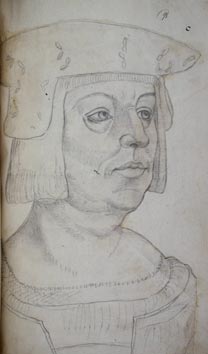 |
Philippe of Burgundy Bishop of Utrecht |
Natural offspring:
a. Philippe de Bourgogne (1464-1524)
Admiral of the Netherlands 1498-1517.
Bishop of Utrecht 1517-1524.
Legitimized 1508
Son of: Philipp III of Burgundy & Margaretha Post.
Bishop of Utrecht's Natural offspring:
Unnamed mistresses.
1. Jean de Bourgogne
2. Philippe de Bourgogne
3. Oliver de Bourgogne (d. after 1532)
4. Baudouin de Bourgogne (1446-1508), Lord of Fallais, Bouddour, Sint-Annaland, Lovendegem en Fromont
11) Margarethe Rose.
11) Margarethe Rose.
12) Marie de Belleval, Dame de Bonville.
13) Marie-Marguerite Scupelins.
14) Mathilde van Praest.
15) Nicoletta de Bosquiel.
Natural offspring:
a. David de Bourgogne (1427-1496), Bishop of Therouanne, Bishop of Utrecht
b. Marie de Bourgogne mar Pierre de Bauffremont, Sire de Charny.
Natural Offspring: .
" . . . He was known . . . for having 24 mistresses and around 18 illegitimate children." (Cross-Channel France: Nord-Pas de Calais - The Land Beyond the Ports: 7)
" . . . Nicole la Chastelaine, David's mother, was given money towards the repair of her Arras house and was provided with a husband by the duke. . . ." (Philip the Good: 134)
16) Unnamed mistress/es.
Natural offspring:
a. Anne de Bourgogne (1435-1508), Governess of Marie de Bourgogne
Wife of: a) Adriaan van Borselen (d.1468) & b) Adolf van Kleve, Lord of Ravenstein (d.1492)
b. Yolande de Bourgogne mar Jean d'Ailly, Baron de Picquigny
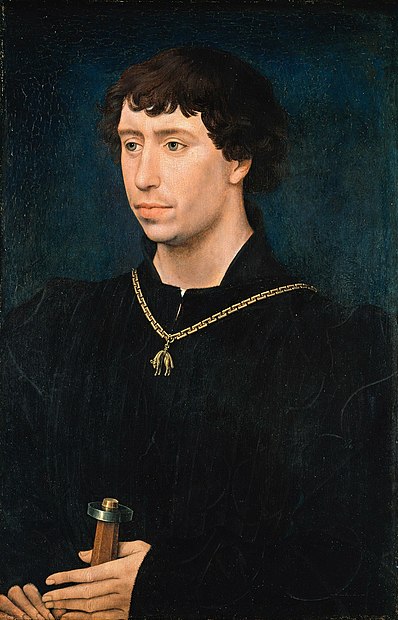 |
| Charles I of Burgundy |
(1433-1477)
Husband of:
1. Catherine de France, mar 1440
2. Isabelle de Bourbon, mar 1454
3. Margaret of York, mar 1468.
Straight or Not?: "If Charles did not normally live with his wife, did he do so with other women? Though he is traditionally supposed to have been chaste, if not puritanical, in contradistinction to his gallant and amorous father, yet he may have left illegitimate descendants in Lorraine. There is some evidence, too, that he was homosexual. At any rate his illegitimate half-brother Baudouin and his associate Jehan de Chassa virtually accused him of buggery when they fled from his court at the end of 1470." (John the Fearless: The Growth of Burgundian Power, Vol 2: 159)
Philippe de Bourgogne, Duke of Brabant and Limburg (1404-1430)
Barbara Fierens.
Balthazar-Philippe-François de Bourgogne (1693-1767)
Seigneur d'Herbamez, d'Ernonval & de Tilly.
Son of: Francois de Bourgogne, Seigneur d'Herbamez, de Tilly-Capelle & de Montsorel & Maria-Anne de Velaire de Zantfort.
Husband of:
1. Marie-Anne-Therese Parents
2. Francoise Dhennin
3. Francoise de Barge.
His lovers were:
1) Francoise de Barge.
2) Francoise Dhennin.
References:





_c_1580.jpg/448px-Magnus_of_Sweden_(1542)_c_1580.jpg)
_c_1595_by_Cornelius_Crommeny.jpg/330px-Lucretia_Gyllenhielm_(daughter_of_Magnus)_c_1595_by_Cornelius_Crommeny.jpg)