Showing posts with label Harriette Wilson. Show all posts

Sunday, March 26, 2017

Beau Brummell----

George Bryan "Beau" Brummell (7 June 1778 – 30 March 1840) was an iconic figure in Regency England, the arbiter of men's fashion  a friend of the Prince Regent, the future King George IV. He established the mode of dress for men that rejected overly ornate fashions for one of understated, but perfectly fitted  tailored clothing. This look was based on dark coats, full-length trousers rather than knee breeches  stockings, and above all immaculate shirt linen and an elaborately knotted cravat.
Beau Brummell
@Pinterest
(1778-1840)
British iconic figure.

Captain of the Tenth Hussars 1796-1798
British Consul at Caen, France 1830-1832.

Son ofWilliam Brummell, British politician & private secretary to Lord North, the British prime minister.

Launch of dandyism attributed to Beau's theatrical originality.
"British-born Beau Brummell (1778-1840) enjoyed meteoric social success despite his common birth. Brummell's theatrical originality won him the affection of the royal family and effectively launched dandyism in both England and France. His reign coincided with the Regency of the future King George IV (1795-1820), who was for a time Brummells' closest friend." (Dandies: Fashion and Finesse in Art and Culture: 36)
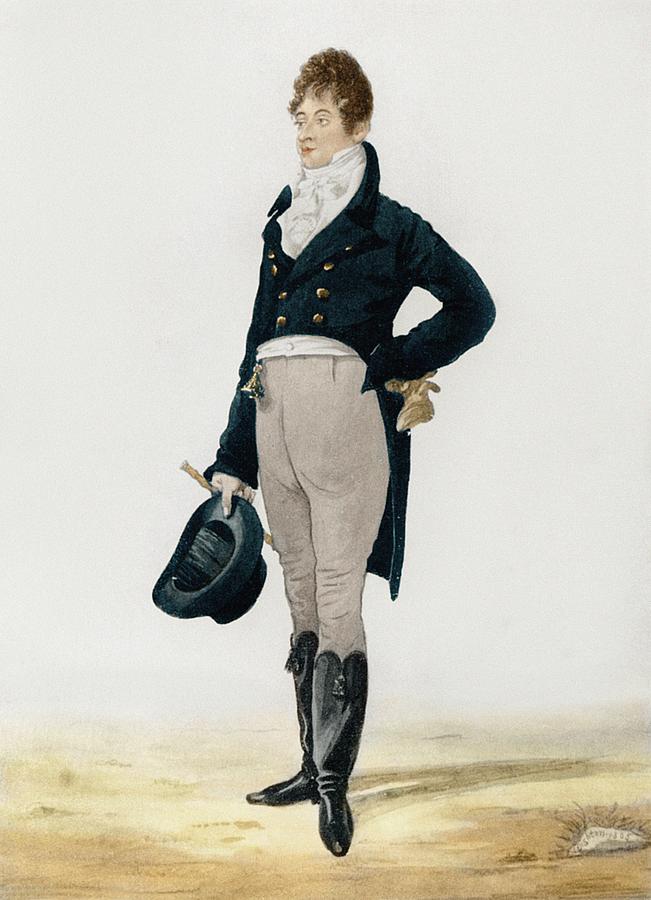
George "Beau" Brummell
by Robert Dighton, 1805
@Priestley's The Prince of Pleasure
Beau's personal & family background.
"Enter one George Bryan 'Beau' Brummell..., son of a former courtesan (she married her protector), grandson of a valet, best man to the Prince of Wales, and thought by some to be, 'the first metrosexual'... Brummell's father, a civil servant in the Treasury who eventually became Lord North's private secretary, amassed significant wealth before both he and his wife died when Brummell was not yet seventeen. . . ." (Heroes and Heartbreakers). 

" . . . His grandfather was a humble shopkeeper in St. James Parish. To earn some extra money, his grandfather would rent rooms to aristocratic gentlemen, which further acquainted George to aristocrats, how they behaved and dressed. . . ." (Historic Boys' Clothing)
Related image
Beau Brummell
@Google
Physical appearance & personal qualities.
"He was not particularly handsome: he was fair, almost red-haired, with a lofty brow, a thin sharp nose which he carried much in the air, his lips slightly compressed, his clear eyes of an indefinable shade---a little quizzing with a strange expression of disdain and alert irony; but he was about the height of Apollo and the proportions of his body were perfect, whilst his hands were particularly well shaped, 'he could indeed have found an engagement to perambulate France from fair to fair to personate the statuary of the ancients'---but he was incomparably distinguished from head to foot." (Beau Brummell: His Life and Times: 41)

"Brummell was known for his impeccable grooming, his exquisitely simple and elegant clothes, and his androgynous appeal. His meticulousness was such that he was known to have hired three glove makers at once: one to make the palm, one for the fingers, and one for the thumb. Brummell's greatest achievement, however, lay in his ability to provoke surprise, desire, and envy, while, on his part, evincing no emotion at all. According to Jules Barbey d'Aurevilly, Brummell's social power was such that he could sometimes persuade creditors to overlook steep gambling debts merely by agreeing to greet them in public in the street. Presumably, the social status acquired by any man whom Brummell deigned to acknowledge would be far more valuable than money." (Dandies: Fashion and Finesse in Art and Culture: 36)
beau-byronic.jpg
Beau Brummell
@Dandyism.net
" . . . He was fair complexioned, and had 'a high nose, which was broken down by a kick from a horse soon after he went into the Tenth Dragoons.. . . ." (Tweedland)

Aftermath.
"The portrait if the Beau is rather sad if one knows how his life ended: as a raving lunatic in a French asylum, the fastidious man of fashion reduced by the ravages of syphilis to a doubly incontinent shadow of his former self." (Brimstone Butterfly)
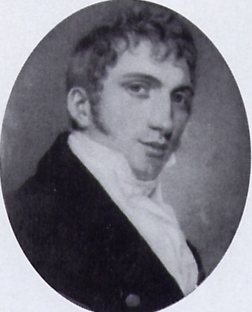
Beau Brummell

His lovers were
:
Lady Elizabeth Howard
Duchess of Rutland
@Pinterest
British aristocrat.

Daughter ofFrederick Howard, 5th Earl of Carlisle & Margaret Caroline Leveson-Gower.

Wife ofJohn Henry Manners, 5th Duke of Rutland 1787, mar 1799.

"He was particular friends with Lady Hester Stanhope, the eccentric bluestocking; Lady Elizabeth Howard, Duchess of Rutland, until his rudeness alienated her; and the Duchess of Devonshire who wrote poems for his collection." (Regency History)

"A contemporary view sheds light on Elizabeth's character. She was a friend of Mrs. Arbuthnot, mistress of the Duke of Wellington, who frequently visited Belvoir. She said Elizabeth had 'extraordinary genius' as well as 'vanity and folly.' According to her, the 'fine ladies' of London did not like her because she was 'far above them.' Perhaps as a result she had few female friends but she was a constant friend to those she had. However, if women did not like her very much, she had no such problem with men, to whom she was very attractive. Although she and the Duke clearly enjoyed at least a degree of intimacy from the number of children they had, he left her alone for long periods. An early admirer of Elizabeth was Beau Brummell, the society dandy. . . ." (Duchesses: Living in 21st Century Britain)
Friederike of Prussia
Duchess of York
@Wikipedia
Lover in 1800?

"But his closest lady friend was Frederica, Duchess of York. He loved her unstructured house parties at Oatlands and shared her love of animals. He gave her a dog, Fidélité; she sent him gifts in exile, including a comfy chair. One of the few items in Brummell’s possession at his death was a miniature of Princess Frederica’s left eye. This suggests a level of intimacy that can only be guessed at. Brummell claimed it was out of respect for promises to the Princess that he refused to publish his memoirs even when he was desperate for money." (Regency History)

"The woman whose friendship endured the longest, and who has the strongest claim to have been the love of Brummell's life, was a royal duchess: Princess Frederica Charlotte Ulrica Catherine, Princess Royal of Prussia and Duchess of York and Albany. She was twelve years his senior. Princess Frederica had grown up in the court of King William II of Prussia, spoke English with a strong German accent and corresponded invariably in French, signing herself 'Frederique.' Brummel wrote back in English. She and Brummell first met in 1800 through her husband, the Prince of Wales's bluff brother Frederick, Duke of York and Albany. The royal couple were already nearly a decade into their childless marriage and nearly as long into an informal though amicable separation. . . ." (Beau Brummell: The Ultimate Man of Style: 143)

3) George Gordon Byron, 6th Baron Byron.
"The strongest case for a Brummell affair with another man is weak, but tempting to consider, as the other party in the story is the bisexual Lord Byron. Brummell kept two poems that Byron had given him in his album. . . ." (Beau Brummell: The Ultimate Man of Style: 201)
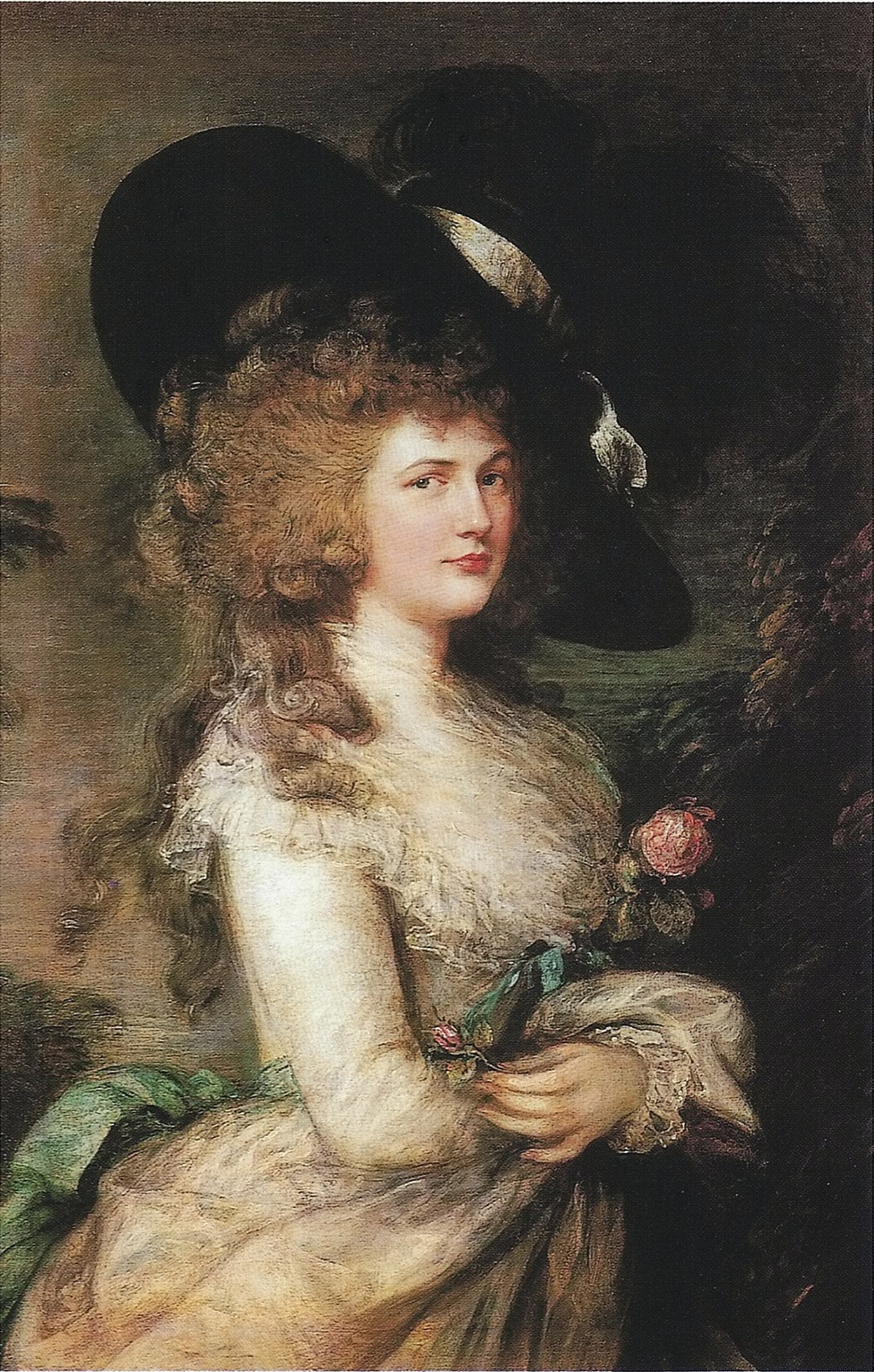
Georgiana Spencer
Duchess of Devonshire

Daughter ofJohn, 1st Earl Spencer & Margaret Georgiana Poyntz.

Harriette Wilson
5) Harriette Wilson (1786-1845)
British courtesan
File:Lady Hester Stanhope by Beeche.jpg
Lady Hester Stanhope
@Wikipedia
6) Lady Hester Stanhope.
"That Lady Stanhope was on terms of close friendship with Brummell is indicated by many episodes and references.
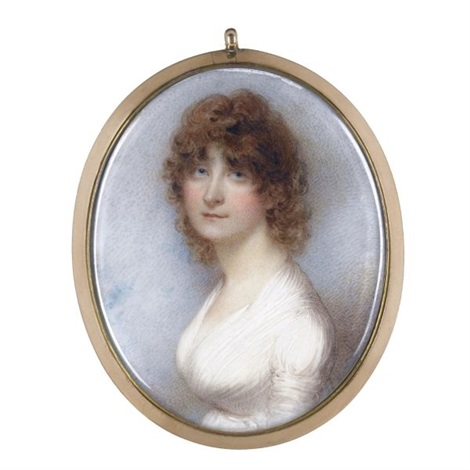
Portrait of Julia Storer, called Mrs Johnstone by William Wood on ...
Julia Storer
@artnet
7) Julia Storer (1777-?)
Lover in 1794
British courtesan

"Julia Johnstone was the assumed name of Julia Storer (born 1777). She was connected to the court, but became a courtesan. She claimed an early relationship with the young George "Beau" Brummell, from around 1794. Her parents were Thomas James Storer (1747–1792) (as John James in Kelly), and his wife Elizabeth Proby, daughter of John Proby, 1st Baron Carysfort, and maid-of-honour to Charlotte of Mecklenburg-Strelitz, the Queen. The Brummells and Storers both had grace and favour apartments in Hampton Court Palace, William Brummell being private secretary to Lord North." (Wikipedia)

" . . . Brummel's (sic) first love was reputedly Julia Storer, later Julia Johnstone, who became a famous courtesan. . . ." (Regency History)

Thursday, September 18, 2014

Central Europe--

HUNGARY.
Laszlo IV of Hungary.
"Laszlo IV favoured his Cuman concubines over his wife and he imprisoned a papal legate who came to excommunicate him in 1279. The voivode of Transylvania forced him to reconcile and the Cumans revolted, so Laszlo defeated them in battle in 1282 and they left. A civil war ended when the Mongols raided in 1284 and some claimed Laszlo invited them into Hungary to help him regain power. He was eventually excommunicated for arresting his wife so he could live with his Cuman mistress, Edua. The Cumans would service their revenge, eventually murdering him." (Clash of Thrones)
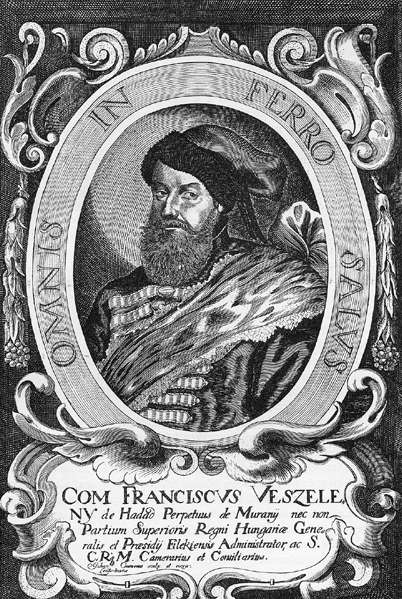
Ferenc Wesselényi
@Wikipedia
Ferenc Wesselényi de Hadad et Murány (1605-1667)
Hungarian military commander and Palatine of the Royal Hungary.

Son of István Wesselényi, royal court counselor of King Ferdinand II of Austria.

Husband of

1.
2. Zsófia Bosnyák
3. Mária Széchy


"Francis Wesselenyi was the Palatine of Hungary, the first man of the kingdom. He was descended from one of the oldest Hungarian houses, which traces its line up to St. Stephen of Hungary. One of his ancestors, as early as the fifteenth century, had held the dignity of palatine of the kingdom, and was one of the first batch of the knights of the Burgundian Golden Fleece. The palatine was a wealthy and jovial man, and had proved his valour in the Turkish war. His wife, the voluptuous, heroic Maria Szetsi, had a principal share in the alleged conspiracy which was prepared against Austria; but she paid very dearly for her adulterous love for her husband's secretary, Francis Nagy, of Lesseny, who rewarded her favours by betraying her to the cabinet of Vienna." (Memoirs of the Court and Aristocracy of Austria, Vol  2: 22)

"After learning of her husband's adultery with his future third wife, Mária Széchy, his second wife, Zsófia Bosnyák, became unhappy and always spent her nights praying in their castle's chapel. She soon became sick and died at the age of 35." (Wikipedia)

His lover was:
Mária Széchy.
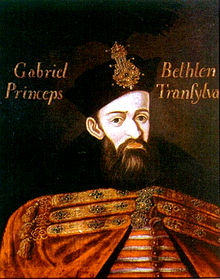
Gabor Bethlen

Husband of
1. ????
2. Katharina von Brandenburg married in 1626.

His lover was:
Unnamed mistress:

Now you see them, now you don't: ". . . Yet is was not only Catherine who had lovers, for the lover affairs of Bethlen also seem to have been well known. According to the official record of the Bavarian delegates at the wedding, the groom was forced to send away his twelve concubines, for had he not done so, the princess would not have appeared at the wedding. . . The source recorded the malicious remarks made by Hungarian lords that he would soon take them back. During their marriage, the Swedish ambassador reported on Gabriel's numerous flirtations love affairs, and concubines. Gabriel also spoke openly about his active sex life. . . . " (The Rule of Women in Early Modern Europe: 84)
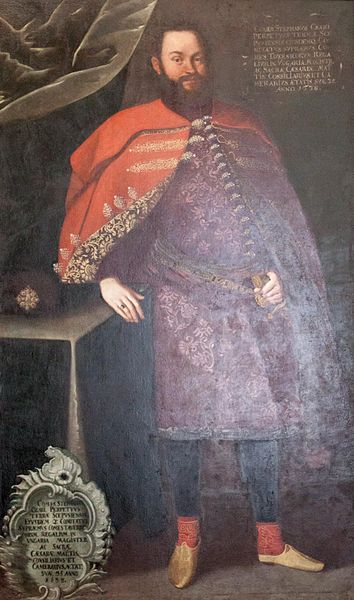
Istvan Csaky
Istvan Csaky (1603-1662)

Husband of
1. Maria Perenyi
2. Krisztina Mindszenti
3. Eva Forgach de Ghymes et Gacs.
[Ref1:] [Ref2:Ars et Anitas]

His lover was:

"...There were many rumors concerning Catherine's affairs during their marriage; after Bethlen's death, the rumors continued to circulate; it was said that Catherine (Katharina von Brandenburg) had an affair first with a Moravian nobleman, then with her doctor. Her long relationships with Count Istvan Csaky (1602-62), a married man, was common knowledge. Csaky was elegant, the same age as Catherine, and according to common opinion, the best-looking Hungarian at the time. Moreover, he was education and spoke excellent German." (
The Rule of Women in Early Modern Europe: 84)

"Gyulafehérvár, 1629. Catherine of Brandenburg, the young wife of the prince is flirting with the married István Csáky, notorious for his seductions, while the rest of the palace is anxiously expecting the arrival of the mortally sick Gábor Bethlen. The old prince arrives on the litter-throne carried by his escort. In his last will, Gábor Bethlen appoints a task to György Rákóczi which is incompatible with the principles of the nobleman, and Rákóczi leaves, denying the errand. For the sake of the unity of Transylvania, Bethlen speaks a few words on behalf of Catherine. When he is left alone at last, he dies peacefully, praying to God. His soul is united with the eternally loving soul of Anna Báthory in heavens. Catherine of Brandenburg is intimidated by the obligations of ruling a country, and runs away with István Csáky - thus it happens that the aristocracy offers the throne of Transylvania to György Rákóczi." (Magda Gyori)

"It would seem that adulterous sexual relationships with married women were so safe that they were very rarely recorded. The most famous case from the seventeenth century, however, that of Istvan Csaky, a relative of the Istvan Csaky mentioned earlier, became common knowledge. He was known by his contemporaries as the lover of Prince Gabor Bethlen's second wife, Katherine of Brandenburg. Even Csaky's mother, Anna Wesselenyi, hinted at the fact in her letters. Csaky and Katherine had no children." (Peter, 2001, pp. 49-50)
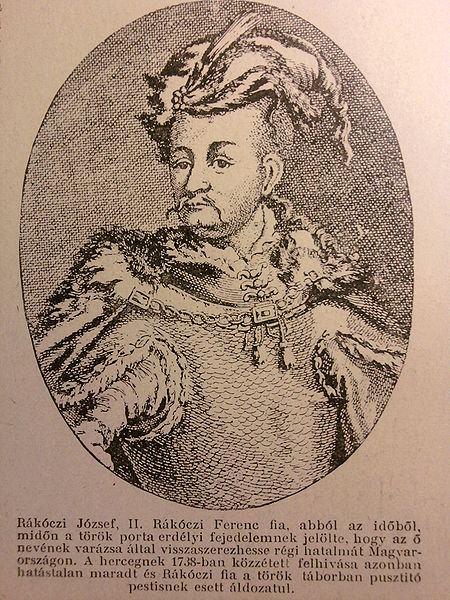
Jozsef Rakoczi
Tolnai-korabeli kep alapjan, 1910
Jozsef Rakoczi (1700-1738).
Duke of Munkacs 1734
Marchese di San Marco 1723.

His lover was:
NN.
[Fam1:GeneAll]

Margit Thyssen-Bornemisza.

Her lovers were:
1) Joachim Oldenburg.

"Meanwhile Margit remained at the castle, where she was provided with a generous allowance from Thyssengas, one of her father's German companies. A Thyssengas employee and Nazi Party member, Joachim Oldenburg, was seconded to assist in managing the estate. Locals employed at Rechnitz report that the 'young dashing and virile' Oldenburg quickly accepted responsibility for accompanying Margit on hunting trips -- and was soon sharing her bed. This despite the fact that, in 1933, Margit had enhanced her social position by marrying an impoverished Count Ivan Batthyany, whose family had originally owned the town of Rechnitz and a large slice of Hungary. In a bizarre arrangement, while the 'countess' shared the castle with her SS guests and her bed with Joachim Oldenburg, her estranged husband continued to enjoy his wife's money and breed horses on one of the Batthyany's adjoining Hungarian estates" (Independent)

2) Franz Podezin.
"Further complicating her domestic arrangements, Margit was also enjoying a dalliance with the sexually ambitious Franz Podezin, a Gestapo administrator and leader of the Rechnitz Nazi Party.
Miklos III, Prince Esterhazy

Husband of:
Maria Josepha von Liechtenstein, mar 1783.

"...From Eisenstadt castle Nicholas II indulged his love of collecting. He collected snail shells, medals, and minerals, all of which were put on display... But his greatest achievement was his magnificent collection of paintings and engravings...But there was another side to Prince Nicholas. His mania for collecting spread to women. He kept numerous mistresses, dotted about western Hungary, each in her own house, and visited them all in turn. He had a marked appetite for young girls, which his entourage did its best to hush up...." (Walker, 1987, p. 43)

"According to Mraz (2009), Nikolaus was known 'for his debauched lifestyle, keeping what amounted to a private brothel in the Landstraße'. One commentator said that he had 200 mistresses and fathered 100 illegitimate children." (Wikipedia)
Pal II Antal
Prince Esterhazy von Galantha

His lovers were:

2) Teresa Vestris (1726-1808)

Italian dancer.

" . . . While performing in Vienna she became the mistress of Prince Esterhazy, a liaison which prompted a jealous Empress Maria Theresa to order the dancer's immediate transfer to Dresden. . . ."  (Craine & Mackrell: 472),  References[Ref1]
Thomas Preljubovic
& Maria Palaiologina
Thomas Preljubovic (d.1384)
Despot of Epirus 1366-1384

Son ofGregorius PreljubSerbian Governor of Thessaly & Irene of Serbia.

Wife ofMaria Angelina Doukaina Palaiologina (1350-1394)
, mar 1366Queen of Epirus 1384-1385.

Daughter ofStephen UrosEmperor of Serbia & Thomais Orsini.

His lover was:
Unnamed mistress.

Natural offspring:
a.Irene (d.1374/75) mar John Losha of Arta.

BOHEMIA.
Ottokar II of Bohemia
Ottokar II of Bohemia (1233-1278).
King of Bohemia 1253.

His lovers were:
1) Agnes von Kuenring.

2) Palczierzik.
[Bio1:Wikipedia]
[Ref2:My WN]