Afonso de Bragança (1403-1460)
1st Marques de Valenca
4th Conde de Ourem.
Son of: Alfonso I de Bragança & Beatriz de Pereira.
His lover was:
Daughter of: Martim Afonso de Souza, Senhor de St. Estevao & Violante Lopes de Tavora.
Natural offspring:
Alfonso de Bragança (d.1522)
Bishop of Evora
Alfonso Enriquez de Castilla (1355-1400)
1st Count of Noreña
1st Count of Gijon.
Lord of Paredes de Nava.
Son of: Enrique II de Castilla & Elvira Íñiguez de Vega (1355-1395).
Husband of: Isabel de Portugal, 2nd Señora de Viseu (1364-1435), mar 1375, daughter of Fernao I de Portugal & Leonor Telles de Meneses.
 |
| Alvaro de Luna, c1430 @Wikipedia |
Alvaro de Luna (1390-1453)
Spanish politician & military man.
Constable of Castile. 1423
Duke of Trujillo
1st Count of San Esteban de Gormaz 1423
Grand Master of the Order of Santiago.
a.k.a. born Alvaro de Luna y Jarana.
Son of: Alvaro Martinez de Luna, Senor de Illueca, Copero mayor to Enrique III de Castilla & Maria Fernandez de Jarana.
Husband of:
1. Elvira Fernandez Portocarrero, mar 1420, daughter of Martin Fernandez Potocarrero, 4th Señor de Moguer & Leonor Cabeza de Vaca.
2. Juana Pimentel (1404-1488), Condesa de Montalban, mar 1430, daughter of Rodrigo Alfonso Pimentel, 2nd Conde de Benavente & Leonor Enriquez de Mendoza.
His lover was:
1) Catalina.
Natural offspring:
a. Maria de Luna, married Juan de Luna, her father's nephew.
2) Margarida Manuel de Vilhena
Señora do Mejorada.
a.k.a. Margarita de Villena, daughter of Henrique Manuel, bastardo de Castilla, Conde de Cea, Conde de Montealegre & Beatriz de Soussa.
Natural offspring:
1. Pedro de Luna, Senor de Fuentidueña.
" . . . The case of Alvaro de Luna, a powerful nobleman and the Castilian royal favorite under Juan II, highlights the difficult nature of noble masculinity in a time of tensions between nobles and between the nobility and the crown. Born in 1390, Alvaro de Luna was himself illegitimate. Provided with a nobleman's education, he was sent to court at the age of 18 to serve as a page to the young Juan II. He contracted two marriages with high-ranking noblewomen. His first marriage produced no children, but he had two legitimate children with his second wife, Juana Pimentel, the daughter of the second Count of Benavente, whose status and rank greatly enhanced his own. Luna also had two illegitimate children with Margarita Manuel, the daughter of the Count of Montealegre. He provided handsomely for both of his illegitimate children, founding entails for them and enabling them to make good marriages." (Contested Spaces of Nobility in Early Modern Europe: 79-80)
" . . . Luna was also credited with introducing Juan's son, Enrique IV of Castile, to homosexual activities, an accusation which in this case did not enhance Enrique's virility but instead allowed his enemies to link the king's name with accusations of both sodomy and impotency. . . ." (Contested Spaces of Nobility in Early Modern Europe: 80)
" . . . Luna was also credited with introducing Juan's son, Enrique IV of Castile, to homosexual activities, an accusation which in this case did not enhance Enrique's virility but instead allowed his enemies to link the king's name with accusations of both sodomy and impotency. . . ." (Contested Spaces of Nobility in Early Modern Europe: 80)
Alavaro Gonsalves Pereira.
Pior of Crato.
a.k.a. Álvaro Gonçalves Pereira.
His lover was:
1) Iria Gonsalves de Carvalhal.
Natural offspring:
"One of the most notable figures of Portuguese history, for instance, Nuno Álvares Pereira, who led the Portuguese army in three consecutive victories over the Castilians and played a decisive part in placing King John I on the throne of Portugal, was one of the thirty-two bastards of prior Alvaro Gonsalves Pereira, master of the Order of the Hospital, his mother being a nursemaid of the court, Iria Gonsalves do Carvalhal." (The Portuguese Columbus: Secret Agent of King John II: 349)

Ana de Mendoza y de la Cerda, Princesa de Eboli (1540-1592)
Also known as:
Doña Ana de Mendoza y de la Cerda
2nd Princess of Melito
3rd Countess of Melito
Marquesa de Algecilla
2nd Duquesa de Francavilla
3rd Condesa do Alian
Duquesa de Pastrana 1569.
Wife of: Don Gomez Ruiz da Silva (1516-1573)
Portuguese noble Secretary of state to King Philip II, mar 1553
" . . . Heir of an ancient noble house . . ., Gomez de Silva was also Prince of Eboli, married to a princess (Dona Ana de Mendoza, 1540-1592) known for her wit and beauty, despite the loss of one eye. Immortalized in Verdi's opera, the princess was doubtless familiar with courtly intrigue, but historians reject the notion of her affair with the king or her infatuation with the unfortunate Carlos. The princess did take the veil briefly on the death of her husband, but soon returned to court. Many years later, with her then lover Antonio Perez, she became involved in dangerous high-level intrigues. Perez escaped abroad and the princess spent the remainder of her life confined to her estates." (History Through the Opera Glass: From the Rise of Caesar to the Fall of Napoleon: 168-169)
Physical Traits and Personal Qualities: "In several documents of the day she is described as a small but beautiful woman of pale complexion that contrasted with her dark hair. She seems to have possessed a strong personality, making her more willing to find than to surrender. Her favorite activities included horseback riding and fencing, and she lost her right eye during a fencing match... Many accused her of being arrogant, domineering, and willful...." (Perez & Ihrie, 2002, p. 203)
Offspring: Ana bore her husband 10 children, 4 of whom died in infancy. (Perez & Ihrie, 2002, p. 203)
Her lover was:

Antonio Perez (1540-1611)
Secretary of King Felipe II of Spain.
Son of:
Gonzalo Perez.
Antonio Perez's personal and family background: He was legalized as a son of Gonzalo Perez, secretary of the council of state of King Carlos I of Spain. (Perez & Ihrie, 2002, p. 204).
"The secretary Antonio Perez was at this period (i.e., 1577) thirty-six years old, the natural son of Gonzalo Perez, and legitimated by diploma from the Emperor Charles the Fifth. (Perez & Ihrie, 2002, p. 204)
Antonio Perez's physical appearance & personal traits: " . . . Documents of the day describe Perez as brilliant, ambitious, elegant to a fault, and handsome. . . ." (Perez & Ihrie, 2002, p. 204)
Graceful in manner, endowed with great powers of mind allied to varied attainments, he was the model of an accomplished Castilian gentleman. With equal case he won the hearts of women and acquired the confidence of men. . . ." Gentleman's Magazine, Vol. 40: 564)

 |
| Alfonso de Aragon Duque de Villahermosa by Roland do Mois |
Alfonso de Aragon, Duque de Villahermosa (1417-1495).
Spanish aristocrat.
a.k.a. Alfonso VI de Ribagorza.
1st Duke of Villahermosa 1476
1st Count of Ribagorza 1469
1st Count of Cortes 1462
Baron of Arenos
Grand Master of Order of Calatrava
Grandee of Spain.
a.k.a. born Alfonso de Aragon y de Escobar.
Natural offspring of: Juan II de Aragon & Leonor de Escobar.
Husband of: Leonor de Sotomayor y Portugal, daughter of Juan de Sotomayor & Isabel de Portugal mar 1477
His lovers were:
1) Elvira de Maldonado.
Natural offspring:
a. Catalina de Aragon
b. Enrique de Aragon, Bishop of Gallipoli.
2) Maria Junquers.
Natural offspring:
a. Juan de Aragon, 1st Duque de Luna (1457-1528)
b. Leonor de Aragon y Junqueres, Condesa de Albayda (1430-?), mar Jaime de Mila, Marques de Albayda.
3) Maria Sanchez Conejo.
Natural offspring:
a. Alfonso de Aragon, Archbishop of Tarragona
b. Fernando de Aragon
[Gen1]
Alfonso de Leon, Señor de Soria, Molina and Cigales (1202-1272)
a.k.a. Alfonso de Molina.
[Fam1]
Son of: Alfonso IX de Leon & Berenguela de Castilla.
Husband of:
1. Mafalda Gonzalez de Lara, mar 1240
2. Teresa Gonzalez de Lara, mar 1244
3. Mayor Alfonso de Meneses, mar 1269.
His lover was:
Teresa Pires de Bragança.
Antonio Fernandez de Cordoba Folch de Cardona Anglesola y Requessens, Duque de Sessa (1550-1606).
Grandee of Spain, First Class
7th Viscount of Iznajar
5th Duke of Sessa
3rd Duke of Baena
4th Duke of Soma
6th Cunt of Palamos
5th Count of Trivento
5th Count of Avelino
4th Count of Oliveros
19th Baron of Bellpuig
5th Baron of Calonge
6th Baron of Linola
Ambassador to Rome.
Husband of: Juana de Cordoba-Cardona y Aragon, ma 1578.
His lover was:
1) Ana Boyer y Figueroa.
Natural offspring:
a. Fernando Manuel de Cardona y Cardona Cordoba
1st Marquess of Berfuerte
b. Mariana de Cordoba y Cardona, mar Count of Biraben.
Beatriz de Bobadilla y Osorio (1462-1501)
Condesa de La Gomera.
a.k.a. Beatriz de Bobadilla y Ulloa
Daughter of: Juan de Bobadilla & Leonor Alvarez de Vadillo, Lady-in-waiting to Queen Leonor.
Wife of:
1. Hernan Peraza, Governor of the Canary Islands (d.1488)
2. Alonso Fernandez de Lugo, mar 1498.
"Beatriz de Bobadilla y Osorio (1462-1501) was the daughter of Juan Bobadilla, an alderman of Medina del Campo, Governor (corregidor) of Madrid, and Chief Huntsman for the Catholic Monarchs, and Leonor Alvarez de Vadillo, whose aunt Leonor Alvarez de Toro had been a lady-in-waiting to Leonor de Aragon, the wife of Fernando de Antequera (Rumeu de Armas 1985: 16). She was known as La Cazadora because her father was Chief Huntsman, in order to distinguish her from her aunt and namesake, Beatriz de Bobadilla, Marchioness of Moya, the queen's childhood friend. She had many admirers, including King Fernando and Christopher Columbus. The king was so smitten by her beauty that the queen arranged that she should be married as soon as possible to Fernan Peraza, Lord of La Gomera and El Hierro, the second son of Diego Garcia de Herrera (d.1485) and Ines de Peraza (d.1503). In 1482 Fernan Peraza was in prison, charged with the murder of the sea captain Juan Rejon, who in 1481 had been forced by storms to take refuge on the island of La Gomera. Queen Isabel agreed to pardon him if he would marry Beatriz de Bobadilla and assist in the conquest of the Canary Islands. The couple were married in November or December 1482, soon after Rodrigo Giron's death, and she received a dowry of 500,000 mrs. After her husband was killed by the natives of La Gomera in 1488, Beatriz de Bobadilla remained a widow for ten years, governing the Canary Islands in the name of her son Guillen Peraza de Ayala (d.1565), I Count of La Gomera (1520), until the latter came of age. She also had a daughter by Fernan Peraza named Ines de Herrera. She wa generous in supplying Christopher Columbus with provisions when his fleet landed at La Gomera on his first journey across the Atlantic in 1492, and she gave him a similar welcome when he returned there in 1493 and again in 1498. A letter from Michele de Cuneo, an Italian member of the crew, to his friend Girolano Annaro, dated 28 October 1495, in which there is a description of the gun salutes and the fireworks displayed in honour of Beatriz during their second visit, reveals that Columbus had been infatuated by her. In 1498 she married Alonso Fernandez de Lugo, conqueror of La Palma and Tenerife, later Governor of the Canaries (Rumeu de Armas: 1985)." (Secrets of Pinar's Game: 487)

Her lovers were:
1) Alonso Giron.
Senor de Caracena.
2) Cristobal Colon.
the world explorer.
"It was only natural that the Portuguese, along with the Spanish, should spread sugarcane to the Cape Verde Islands and the Canary Islands in the last decade of the fifteenth century. In August 1492, Christopher Columbus stopped at La Gomera in the Canaray Islands for wine and water, intending to stay only four days. But he became romantically involved with the governor of the island, Beatriz de Bobadilla y Ossorio, and ended up staying a month. When he finally sailed, she gave him cuttings of sugarcane, which he took to Hispaniola and planted, thus expanding sugarcane's cultivation to the New World, or so the story goes." (Precious Cargo: How Foods from the Americas Changed the World: 99)
2) Fernando II de Aragon.
3) Rodrigo Tellez Giron
Maestre de Calatrava.
Beatriz Enriquez de Arana (1467-1521)
Her lover was:
Cristobal Colon
Lover in 1488
Personal & Family Background: "During this time in Spain waiting to get approval for his voyage he met another woman, Beatriz Enriquez de Arana (1465-1520), Although Columbus never married her, in 1488 she bore him a second son, Fernando, out of wedlock. She was a peasant woman, who had been introduced to Columbus by a relative of hers, Diego de Arana, an officer on Columbus’ first voyage".
a.k.a. Bernardino I Fernandez de Velasco y Mendoza.
1st Duque de Frias
3rd Count of Haro
2nd Constable of Castile
11th Lord of Velasco
Captain-General of Granada
Viceroy of Granada.
Husband of:
1. Blanca de Herrera y Niño, Señora de Pedraza, daughter of
Garci Gonzalez de Herrera, Marshal of Castile, 3rd Señor de Pedraza & Maria Niño de Portugal.
2. Juana de Aragon, daughter of Fernando II de Aragon.
His lovers were:
1) Clara de Orense.
Natural offspring:
a. Juan de Velasco
b. Isabel de Velasco
2) Ines Enriquez de Sagrado.
Natural offspring:
a. Bernardino de Velasco, Señor de Castelgeriego.
b. Pedro Fernandez de Velasco y Figueroa.
Reference for Bernardino I Fernandez de Velasco
Duque de Frias.

Diego Hurtado de Mendoza, 1st Duque de Infantado (1417-1479)
Spanish aristocrat.
1st Duque de Infantado 1475
2nd Marques de Santillana 1458
1st Marques de Argueso
1st Marques de Campo
2nd Conde del Real de Manzanares
4th Señor de Hita y Buitrago.
Also known as:
Dom Diego Hurtado de Mendoza y Figueroa
Diego Hurtado de Mendoza y Suarez de Figueroa.
Son of:
Íñigo López de Mendoza y Lasso de la Vega, 1st Marques de Santillana & Catalina Suarez de Figueroa
Husband of:
1) Brianda de Luna y Mendoza, daughter of Juan Hurtado de Mendoza & Maria Martinez de Luna
2) Isabel Henriques de Noronha, daughter of Rui Vaz Pereira & Beatriz de Noronha.
His lover was:
Maria Cabrera.
Diego de Mendoza
His lover was:
Mencia de Ayala.
"...Diego had added insult to injury by naming his mistress and cousin, Mencia de Ayala, as executor of his will. Mencia could bring powerful support to her side; her father, the royal chronicler Pedro Lopez de Ayala, was still active though retired as the chancellor of Castile.
"...In 1404 Diego Hurtado de Mendoza, admiral of Castile, appointed his wife Leonor as one of the guardians of his children. He also appointed his uncles, Pedro Lopez de Ayala, canciller mayor of Castile, and Juan Hurtado de Mendoza, military governor of Vizcaya, to share the guardianship with her. He clearly hoped to protect his still very young children by commending them to the care of his most powerful relatives. Diego, however, lived apart from his wife and shared his bed with his cousin and mistress, Mencia de Ayala, daughter of the Pedro whom he had appointed as one of the guardians of his children. Diego also appointed Mencia as one of the executors of his will, leaving his wife at her mercy when Mencia refused to vacate the family palace in Guadalajara. Furious with the position she had been placed in, Leonor severed all ties with the Ayala family, and the other guardian, Juan Hurtado de Mendoza, devoted his time to the political feuds of the day. This left Leonor to carry out her guardianship without the family members who had been appointed to help her." (Coolidge, 2010, pp. 50-51) [Ref1:16]
Diego Hurtado de Mendoza.\, Principe de Melito.
His lover was:
Luisa de la Cerda (d.1596)
"Luisa also had a daughter, who would tangentially connect Luisa with the Mendozas. Isabel was the illegitimate fruit of Luisa's premarital liaison with Diego Hurtado de Mendoza, the prince of Melito. This liaison could be interpreted as a sign of the power and freedom of a highborn lady such as Luisa. Closer examination of the stage of life in which the even occurred, however, reveals a disparity between the powerful position of her lover and her own youth and status as an orphan... In any case, having borne a child out of wedlock did not prevent Luisa from later making an advantageous marriage." (Nader, 2004, p. 114)
Diego Lopez Pacheco (1503-1556)
3rd Duque de Escalona.
His lover was:
Unnamed mistress.
Diego Roque Lopez Pacheco (1599-1653)
7th Duque de Escalona
7th Marques de Villena.
His lover was:
Unnamed mistress.
Infante de España.
His lover was:
Barbara Kastner (1750-1811)
Daughter of: Joseph Kastner & Ana Maria Schneider.
Husband of: Anton Joseph Mayfren, mar 1782.
Natural Offspring:
a. Emmanuela Maria Felipa Mayfren.
b. Juana Josefa Lorenza Barbara Mayfren.
 |
| Francisco de Paula de Portugal 7th Duque de Beja |
Francisco de Paula de Portugal, 7th Duque de Beja (1691-1742).
His lover was:
Mariana da Silveira.
[Bio2:Wikipedia]
Gabriel Antonio de Borbon, Infante de España (1752-1788)
Son of: Carlos III de España & Maria Amelie von Sachsen.
Husband of: Maria Ana de Braganza, Infanta de Portugal, mar 1785.
His lover was:
Barbara Kastner (1750-?)
Natural offspring:
Emmanuela Maria Felipa Mayfren.
Natural offspring:
1. Pedro Carlos de Borbon, y Braganza, Infante de España
2. Maria Carlota Josefa de Borbon, Infanta de España
3. Carlos de Borbon, Infante de España.
 |
| Gaspar de Guzman Count-Duke of Olivares |
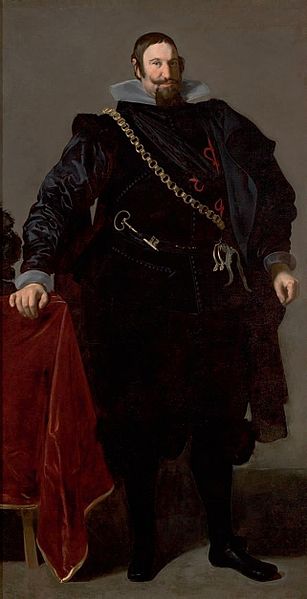
Gaspar de Guzman, Conde-Duque de Olivares (1587-1645).
a.k.a. Gaspar de Guzman y Pimentel Ribera y Velasco de Tovar
Conde de Olivares
Duque de San Lucar la Mayor.
Prime Minister of Spain (1621).
His lover was:
Isabel de Anversa
"Julian was the son of Dona Isabel de Anversa, a noted courtesan of Madrid. In Gil Blas c. xii, her name is given as Isabel Margherita Spinola. When the youth was about eighteen years of age, Olivares, who was ranked among the numerous admirers of the mother, compelled D. Francisco Valcarcel to acknowledge the boy as his son. Twelve years later Julian married a woman of the same profession as his mother; but about this time the Count Duke, his only daughter having died [in 1626], resolved to give the scrapegrace the benefit of a doubt, and recognized him as his own son, bestowed upon him the name of Henrique Philippe (sic) de Guzman, made him his heir, created him Duque de San Lucar, induced the Pope to annul his marriage, and forced the Duque de Frias, hereditary Constable of Castile, to give his daughter to the upstart...." (Curtis, 1883, p. 80) [Fam1:GeneAll]
Joao Afonso de Albuquerque (1304-1354)
Portuguese aristocrat & politician
6th Conde de Albuquerque
Senhor de Azagala
Senhor de Codosera
Senhor de Alconchel
Senhor de Medellin
Senhor de Meneses
& Senhor de Tiedra.
Alferez of Alfonso XI de Castilla y Leon 1333-1336
Chancellor of Castile 1350-1353
Mayordomo mayor of Infante Pedro,
later Pedro I de Castilla
a.k.a. Joao Afonso o do Ataude.
Son of: Afonso Sanches (son of Dinis I de Portugal & Aldonza Rodrigues Telha) & Teresa Martis de Meneses (daughter of Joao Afonso Teles de Meneses, 1st Conde de Barcelos & Teresa Sanchez, natural daughter of Sancho IV de Castilla).
Husband of: Isabel Tellez de Meneses, 10th Senhora de Meneses, his first cousin, (daughter of Tello Afonso de Meneses & Maria de Portugal), married 1323/24
His lovers were:
1) Maria Gil.
Natural offspring:
a. Pedro Gil de Alburquerque
2) Maria Rodrigues Barba.
2) Maria Rodrigues Barba.
daughter of Rui Martins Barba & Iria Martins Alardo.
Natural offspring:
a. Fernando Afonso de Albuquerque, Senhor de Vila Nova de Ancos, Master of the Order of Santiago
b. Beatriz Afonso de Albuquerque
married Joao Afonso Telles de Meneses, 6th conde de Barcelos, Almirante de Portugal
. cMaria Afonso de Albuquerque, married Gonçalo Telles de Meneses, 1st Conde de Neiva, Senhor de Faria.
Juan Pacheco, Marques de Villena (1419-1474)
Marques de Villena
Conde de Xiqune
1st Duque de Escalona
Master of the Order of Santiago
Great Chamberlain to the King.
His lovers were:
1) Catalina Alonso Urueña.
Natural offspring:
a. Juan Pacheco
b. Isabel Pacheco
2) Enrique IV de Castilla.
Natural offspring:
Unknown mistresses:
3. Alonso Pacheco
4. Rodrigo Pacheco
5. Beatriz Pacheco
6. Leonor Pacheco.
Villena, thus granting his advisor untoward wealth. He even named Pacheco's scurrilous brother Pedro Giron to be master of the Order of Calatrava, the second-most powerful military brotherhood in Castile...." (Stuart, 2004, p. 24)[Fam1:Geneall]
2. Syliane Stella Morell , (married 1974, divorced 1995)
3. Begona Aranguren, (married in 1999).
"Julie's first great love was for Don Jose y Gonzaga (sic), Marques de Mora (sic), son of the Spanish ambassador. Proud of carriage and with handsome features, Mora was also a serious-minded young man eager to establish contact with the leading intellectual and philosophical circles in Paris. Julie de Lespinasse met him toward the end of 1766. He was twelve years her junior, a Spanish grandee, wealthy and influential, and a passing visitor to Paris. No wonder, therefore, that his disapproving relatives did everything to separate him from her. They nevertheless managed to see each other now and then and to exchange inflamed letters, for he fully returned her love. It turned out, however, the Mora was a consumptive, and repeated cures at various spas did not prevent his premature death in 1744 at the age of thirty...." (Sartori & Zimmerman, 1994, p. 299)
 |
| Jose Isidro Osorio y de Silva 8th Duque de Sesto |
Jose Isidro Osorio y de Silva, 8th Duque de Sesto.
Spanish author, aristocrat & actor.
a.k.a. Jose Luis de Vilallonga y Cabeza de Vaca.
Husband of:
1. Hon. Essylt-Priscilla Scott-Ellis, (married 1945; divorced 1972)2. Syliane Stella Morell , (married 1974, divorced 1995)
3. Begona Aranguren, (married in 1999).
His lovers were:
French actress.
Jose Maria Pignatelli de Aragon y Gonzaga (1744-1774).
Juan de Borbon, Conde de Montizon (1822-1887)
His lover was
Eliza Bonneville.
Juan Jose de Austria (1629-1679)
Governor-General of the Netherlands
Viceroy of Naples & Catalonia.
a.k.a. John of Austria the Younger.
His lover was:
Anna de Ribera.
[Gen1]
Juan Nunez III de Lara.
His lover was:
Mayor de Leguizamon.
"...The last Lara descendant in the main line, Pedro Nunez, was the illegitimate child of Juan Nunez III de Lara and Dona Mayor de Leguizamon (a noblewoman from Vizcaya); he served quietly under Juan I. He enjoyed the lordship of Castroverde, was made Count of Mayorga in 1381 (as part of a long effort to shore up the Trastamara dynasty), and following year was granted the monastery of Begona, in Bilbao, as a reward for his loyalty in the king's service... He died without succession in 1384, killed by the plague during a siege of Lisbon...." (Doubleday, 2001, p. 178)
Juan Ponce de Leon, 2nd Conde de Arcos (1400-1474)
2nd Conde de Arcos (1448)
Marques de Cadiz (1471)
6th Señor de Marchena.
a.k.a. Juan II Ponce de Leon
Husband of:
1. Leonor de Guzman de Silva (d.1441)
2. Leonor Nunez Gudiel de Prado, married in 1448.
His lovers were:
1) Catalina de Perea Carrizosa.
2) Catalina Gonzalez de Oviedo.
3) Leonor Núñez Gudiel de Prado.
"Another error I discovered goes back beyond Juan Gonzalez Ponce de Leon to his ancestor, Juan Ponce de Ayala the second count of Arcos and his many marriages and affairs he had with his mistresses who bore him many children. . . ." (Ayes: 32)
"The fifteenth-century counts of Arcos are good examples of the benefits of this unofficial form of polygamy. Two generations of the family lacked a legitimate heir and turned to illegitimate descendants to keep the title and estate together. The second Count of Arcos, Juan Ponce de Leon, was married to his niece Sancha, but their marriage did not produce any children. Juan, however, had left nobody in any doubt about his won virility. He had at least three mistresses and about 26 illegitimate children. One of his mistresses seems to have been a maid or lady-in-waiting in his household since he commended her in his will 'for the seventeen years she has served me here in my house and been with me and worked with these my children.'. . . ."
"The fifteenth-century counts of Arcos are good examples of the benefits of this unofficial form of polygamy. Two generations of the family lacked a legitimate heir and turned to illegitimate descendants to keep the title and estate together. The second Count of Arcos, Juan Ponce de Leon, was married to his niece Sancha, but their marriage did not produce any children. Juan, however, had left nobody in any doubt about his won virility. He had at least three mistresses and about 26 illegitimate children. One of his mistresses seems to have been a maid or lady-in-waiting in his household since he commended her in his will 'for the seventeen years she has served me here in my house and been with me and worked with these my children.'. . . ."
" . . . The second Count of Arcos, Juan Ponce de Leon, was married to his niece, Sancha, but their marriage did not produce any children. Juan, however, had left nobody any doubt about his own virility. He had at least three mistresses and about 26 illegitimate children. One of his mistresses seems to have been a maid or lady-in-waiting in his household since he commended her in his will 'for the seventeen years she has served me here in my house and been with me and worked with these my children.' Another mistress is mentioned by name in his will, but she does not carry any noble title. After his wife's death, Rodrigo married his third mistress, the noblewoman Leonor Nunez. In 1448 hr obtained a royal decree to legitimize their children. This marriage and legitimation provided him with a son, a legal heir, and the ability to transfer his property to another male member of his lineage. His eldest surviving son, Rodrigo Ponce de Leon, inherited the title and became the third Count of Arcos." (Romaniello & Lipp. Contested Spaces of Nobility in Early Modern Europe: 72)
Leonor de Sotomayor, Duquesa de Villahermosa.
Daughter of: Juan de Sotomayor & Isabel de Portugal-Eca.
Wife of: Alfonso de Aragon, Duque de Villahermosa.
Her lover was:
Diogo de Portugal.
Duque de Beja.
Lino del Prete.
Alice de Borbon.
Infanta de España.
Lope de Luna, 1st Conde de Luna, Señor de Segorbe (d.1360)
Son of: Artal de Luna y Urrea, 8th Señor de Luna & Martina Sanz de Huerta.
Husband of:
His lover was:
Maria de Altura.
Luis de Hijar (d.1554)
Duque de Hijar y Lecera.
Son of: Juan de Hijar (d.1509), Conde de Belchite & Isabel Ramirez de Avellano.
Husband of:
1) Beatriz de Alagon
2) Hipolita Fernandez de Heredia.
His lover was:
Unnamed mistress.
Natural offspring:
a. Francisco
b. Didac
Luis Alfonso de Borbon, 2nd Duque de Ansola (1887-1942)
Son of: Luis de Borbon, 1st Duque de Ansola & Maria Ana Germana , Bernaldo de Quiros y Munoz, 1st Marquesa de Atarfe.
Husband of: Beatrice Maria Harrington, mar 1914.
His lovers were:
1) Georgette Pages.
Natural Offspring:
Luis Jorge de Bourbon (1922-2005)
2) Marcelle-Fernande-Marthe Doyhamboure.
Natural Offspring:
Philippe-Serge de Borbon (1935-?).
Luis Antonio de Borbon y Farnese, Infante de España (1727-1785)
13th Conde de Chinchon.
His lovers were:
1) Antonia Maria Rodriguez.
A maid in his household
Lover in 1773.
2) Maria Perez.
[Ref1:Alexander Palace]
 |
| Marques de Soveral @ Vanity Fair |
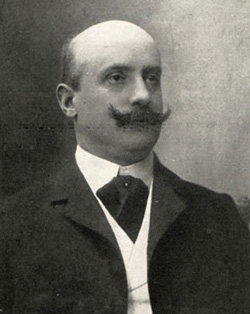
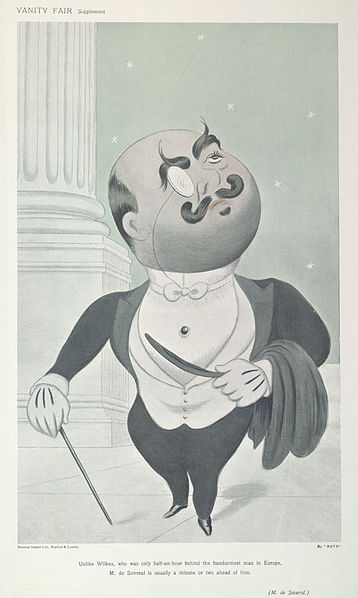
Luis Pinto de Soveral, 1st Marques do Soveral (1851-1922)
Portuguese aristocrat & diplomat.
Minister of Foreign Affairs 1895
Son of: Eduardo Pinto de Soveral, Visconde de Sao Luis & Maria da Piedade Paes de Sande e Castro.
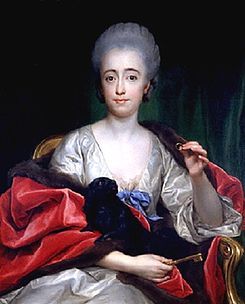 |
| Mariana de Silva-Bazán & Sarmiento @Wikipedia |
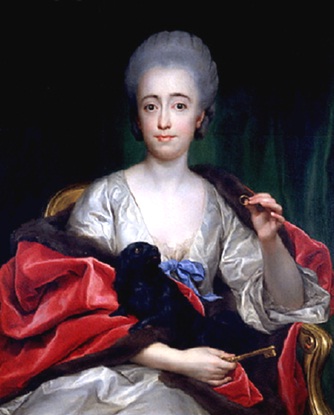
Maria Ana de Silva Sarmiento y de Sotomayor (1739-1784)
Also known as:
Maria del Pilar Ana de Silva-Bazán and Sarmiento
Mariana de Silva-Bazán and Sarmiento.
Daughter of Pedro Artal, 8th Marques de Santa Cruz & del Viso and Maria Cayetana, Condesa de Pie de Concha & Marquesa de Arcicollar.
Wife of:
1. Francisco de Paula de Silva and Alvarez de Toledo, 10th Duque de Huescar.
2. Joaquin Anastasio Pignatelli of Aragon and Moncayo , 16th Conde de Fuentes.
3. Antonio Ponce de Leon y Spinola de la Cerda , 11th Duque de Arcos, mar 1778.
Her lover was:
1) Marques de Mora.
"Don Fernando Francisco de Paula de Silva y Alvarez de Toledo died suddenly on Thursday, April 26, 1770, on the seventh day after being attacked by a 'stabbing pain in his side in the house or palace of Barquillo, which his father had just purchased,' according ti the death certificate. Maria Teresa was only right years old at the time, and people were already talking about her beauty and daring wit. Her mother, Dona Maria Ana, consoled her widowhood by having an affair with the marquis de Mora, lover as well of Mademoiselle de Lespinasse, and the actress Mariquita Ladvenant, with whom he had four children. In spite of his lubricious youth, the young marquis had been recommended to Voltaire himself by D'Alambert, and three or four times a year he would make his pilgrimage to Chateau Ferney to kiss the hands of the maestro. He died of consumption, spitting blood, in Bordeaux in the autumn of 1773. . . ." (The Valley of the Fallen: 88)
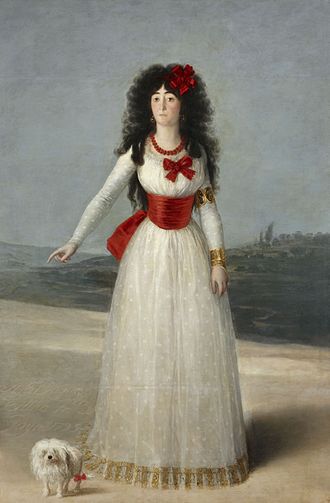
Maria Cayetana de Silva, 13th Duquesa de Alba de Tormes (1762-1802)
[Bio1]
Her lover was:
Francisco Goya
Lover in 1794
"...Two years later, in 1794, Francisco began a love affair with Maria del Pilar Teresa Cayetana de Silva y Alvarez de Toledo de Alba (1762-1802), wife of the Duke of Alba. The Duchess of Alba was one of the most controversial and influential figures in Goya's life. Their intense, passionate, stormy, and neurotic relationship reflected the characters of both, particularly of Cayetana. In 1706, after the death of the Duke of Alba, Goya moved in with the widowed Cayetana on her country estate, where they loved together for 11 months." (Falk: 4)
Maria del Pilar de Mujeguiro y Beruete, Duquesa de Villafranca (1869-1926)
Her lover was:
Basil Zaharoff (1849-1936)
Also known as: Zacharias Basileios Zacharoff
" . . . In 1889, while he was ranging Europe---particularly Russia---for orders, he met Maria del Pilar Antonia Angela Patiocinio (sic?) Simona de Muguiro y Berute, the Duchess of Villafranca. She was the wife of a young man closely connected with the royal family of Spain. She proved useful to Zaharoff in arranging connections in Spain that enabled him to sell many millions of dollars of arms to the war department. But Zaharoff fell in love with her and urged her to divorce her husband, who was ill and on the verge of dementia, The Duchess, a good Catholic, would not consider divorce, but she became Zaharoff's mistress, confident that her husband was destined for a speedy death. His mind failed completely, he was put into an insane asylum, and proceeded to disappoint the Duchess and her lover by continuing to live for another thirty-five years. She continued as Zaharoff's mistress; he remained attached to her with singular devotion and in 1924, when her husband died, the two lovers---then aged and near the end of their lives, he seventy-five and she over sixty---were married in a little town outside Paris. They had had two daughters. The Duchess, however, survived this marriage by only eighteen months and her death left the aged bridegroom inconsolable." (Flynn, 1941, pp. 349-350)
Personal & Family Background: He was the only son of Basilius Zacharoff of Constantinople.
Physical Traits & Personal Character: "About the time he met the Duchess, Zaharoff established a home in Paris. He was rich and a man of striking, distinguished appearance; a small mustache and imperial and drooping eyelids added an expression of inscrutability to his grave countenance. He cultivated the habit of silence. He avoided displays, public appearances. He took up his place in that foggy, ill-lighted world so fascinating to the readers of newspapers — the world of Behind the Scenes. He had acquaintances, if not friends, among the most important people in Europe. He was now a part owner, sales delegate, guiding spirit of a growing British armament firm, but with his home in France. He spoke Turkish, Greek, French, Italian, German, and probably various Balkan dialects. And the world was unfolding auspiciously if not beautifully before him in the grim business in which he flourished." (Flynn: 377) [Bio2] [Bio3] [Bio4]
Maria Manuela Kirkpatrick, Condesa de Montijo (1794-1879)
a.k.a. Maria Manuela Enriqueta Kirkpatrick de Closbourn y de Grevigne, Condesa de Montijo.
Daughter of: William Kirkpatrick & Marie-Francoise de Grivegnee.
 |
| The Countess of Montijo and her daughters Paca & Eugenia |
 |
| Cipriano de Palafox y Portocarrero Conde de Teba, c1820 |
Wife of: Cipriano de Palafox y Portocarrero, Conde de Teba.
(1784-1839)
Spanish aristocrat, military officer & politician
8th Count of Montijo
12th Count of Baños
9th Count of Santa Cruz de la Sierra
18th Count of Miranda del Castañar
7th Count of Fuentidueña
19th Count of San Esteban de Gormaz
8th Count of Ablitas
Marquis of Algava
14th Marquis de La Bañeza
14th Marquis de Mirallo
13th Marquis de Valdunquillo
9th Marquis de Valderrabano
8th Marquis de Osera
16th Marquis de Villanueva del Fresno
Marquis de Barcarrota
17th Marquis de Moya
Duke of Granada
13th Duke of Peñaranda del Duero
Grandee of Spain 1834
25th Lord of Moguer
Lord of Procer del Reino 1834-1835
Senator for Badajoz Province 1837-1838.
Son of Felipe Antonio de Palafox & Maria Francisca Portocarrero.
Her lovers were:
1) Cipriano de Guzman y Palafox y Portocarrero
Conde de Teba.
"Born on 5 May 1826 in Granada, Eugenie Ignacia Augustina was the daughter of Dona (sic) Maria Manuela Kirkpatrick, whose father, William Kirkpatrick of Dumfries in Scotland, had fled Scotland after the 1745 Stuart rebellion and settled in Andalusia. Her father was almost certainly the Spanish Count of Teba, Don Cipriano de Guzman y Palafox y Portocarrero, the younger brother of Don Eugenio, Count of Montijo. Gossip, however, murmured that Eugenie's father was either Lord Palmerston or Lord Clarendon until her mother wryly pointed out to Louis Napoleon, 'But, Sire, the dates don't correspond.'...." (Mostyn: 10)
 |
| George Villiers 4th Earl of Clarendon |
2) George Villiers, 4th Earl of Clarendon (1800-1870)
English aristocrat, statesman & diplomat.
Chancellor of the Duchy of Lancaster.
Son of: Hon. George Villiers & Theresa Parker.
"Their daughters were María Francisca de Sales (1825–1860), generally known as 'Paca', who inherited most of the family honours, and María Eugenia, born one year later. In the 1830s Manuela and the girls moved to Paris for their education. There she renewed her association with George William Frederick Villiers, later Earl of Clarendon, who is rumoured to have been her lover. Manuela also continued her friendship with Prosper Mérimée, whom she had met in Spain and who took great interest in the education of the girls. Manuela was Mérimée's source for the story of Carmen." (Wikipedia)
 |
Pedro Afan de Ribera 1st Duque de Alcala de los Gazules |
Pedro Afan de Ribera (1509-1571)
Spanish aristocrat
1st Duque de Alcalá de los Gazules 1558
2nd Marques de Tarifa
6th Conde de Los Molares
Adelantado of Andalusia
Viceroy & Captain-General of Catalonia 1554-1558
Viceroy & Captain-General of Naples 1559-1571.
Also known as:
Pedro Enriquez Afan de Ribera
Per Afan de Ribera y Portocarrero
Perafan de Ribera y Portocarrero.
Son of: Fernando Enriquez de Ribera & Ines Portocarrero.
Husband of: Leonor Ponce de Leon, daughter of Marques de Zahara.
His lovers were:
1) Teresa Pinelo.
Natural offspring:
a. Saint Juan de Ribera, Archbishop of Valencia, Patriarch of Antioch
2) Luisa Mosquera y Esquivel.
Natural offspring:
1. Catalina de Rivera y Mosquera, married Pedro Barroso, Marques de Malpica.
"Fadrique's brother having died before, his titles devolved upon his nephew, Per Afan Ribera III (1509-71), 2nd Marquis of Tarifa, 6th Count of Los Molares, and-- subsequently --1st Duke of Alcala de los Gazules. None of these titles, however, would be passed on to Per Afan's only son, Juan de Ribera, the illegitimate offspring of Per Afan and a local noblewoman, knew that despite his father's open recognition of paternity he would never inherit the Casa de Pilaton. Upon the premature death of his mother, his sister Catalina took over the responsibility of caring for him; years later he would reward her for this act of kindness with a regular stipend for the rest of her life. . . ." (Between Christians and Moriscos: Juan de Ribera and Religious Reform in Valencia, 1568-1614: 2) [Somos Primos]
Pedro Lopez de Ayala.
Señor de Unza
Señor de Mena
Señor de Albudeite
Adelantado mayor of Murcia.
His lover was:
Ines de Azagra.
Pedro Tellez Giron (1423-1466)
Master of the Order of Calatrava
Camarero mayor de Enrique IV de Castilla, 1457-1465
His lover was:
Isabel de las Casas.
Natural offspring:
a. Alonso Tellez Giron
Legitimated 1453
Conde de Urena 1464
b. Juan Tellez Giron (1457-1528)
Legitimated 1459
Conde de Urena
married 1480 Leonor de la Vega Velasco (daughter of
Pedro Fernandez de Velasco, Conde de Haro & Mencia Mendoza.
 |
Ramon de Pignatelli
|
Ramon de Pignatelli (1734-1793)
a.k.a. Ramon Pignatelli de Aragon y Moncayo.
"El Conde de Fuentes had a brother, Ramon, who became chief of the Saragossa Inquisition and canon of the Saragossa cathedral---the same Father Ramon Pignatelli who blessed the marriage of Maria Cayetana. Most interesting about this eminent churchman is that every night he slept with a different girl. Casanova tells us that he would get up in the morning exhausted by pleasure; the young lady would be driven away, the procuress jailed. 'He then dressed, confessed, said mass and, after an excellent breakfast with plenty of good wine, he would send out for another girl....' The people of Saragossa held him in great respect. After all, he wa a canon of the Church, a monk, an Inquisitor." (Connell, 2004, p. 85) [Ref1:Wikipedia] [Bio2:Gran Enciclopedia Aragonesa] [Ref1:8]
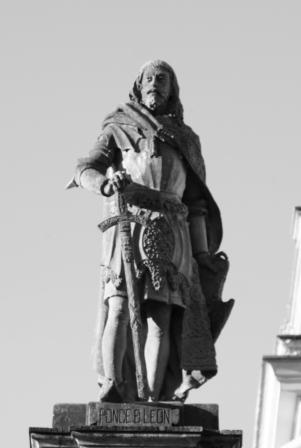 |
| Rodrigo Ponce de Leon 3rd Conde de Arcos |
Rodrigo Ponce de Leon, 1st Duque de Cadiz (1443-1492)
Castillian noble and soldier.
2nd Marquess
1st Duque de Cadiz
1st Marquess de Zahara
3rd Conde de Arcos
7th Señor de Marchena
Señor de Rota.
[Ref1]
Son of: Juan II Ponce de Leon, & mistress Leonor Nuñez Gudiel.
Husband of:
1) Beatriz Fernandez de Marmolejo, Señora de Torrijos
married in 1457; dissolved later.
2) Beatriz Pacheco y Portocarrero, married in 1471.
His lover was:
Ines Bezerril y de la Fuente
a.k.a. Ximenez de la Fuente
"...After his wife's death, Rodrigo married his third mistress, the noblewoman Leonor Nunez. In 1448 he obtained a royal decree to legitimize his children. This marriage and legitimation provided him a son, a legal heir, and the ability to transfer his property to another male member of his lineage. His eldest surviving son, Rodrigo Ponce de Leon, inherited the title and became the third Count of Arcos." (Romaniello & Lipp, 2011, p. 72)
"The third Count of Arcos (1443-92) again depended on a mistress with some social status to save a troubled dynasty and allow him to fulfill his masculine responsibilities by passing on the estate and title to his own descendants. The count, Rodrigo Ponce de Leon, had no legitimate children from either of his two marriages, but he did have three illegitimate daughters with his mistress Ines de la Fuente (thereby establishing his sexual potency). Like Juan de Velasco's lover Ana, Ines is described as 'the daughter of a hidalgo from Marchena.' Rodrigo used the presence of Ines and her offspring to repair his masculine image and create a legitimate male heir. He legitimated his eldest daughter, Francisca, and stipulated in his will that his title should pass to her son. He then arranged for her to marry a distant cousin, Luis Ponce de Leon, the lord of Villagracia. Their son, Rodrigo, inherited the title at a very young age and became the first Duke of Arcos. A list of the titled males in the house of Arcos shows the title passing from Rodrigo, the third Count of Arcos, directly to Rodrigo, the first Duke of Arcos, with no public mention of either Ines or Francisca." (Ramaniello & Lipp, 2011, p. 73)
"Some men turned to their wives as guardians of their children even if their wives were not the children's mothers. A striking example of this comes from the family of Rodrigo Ponce de Leon (1443-92), the count of Arcos and the marquis of Cadiz. Rodrigo was a war hero who married twice without producing any children. He had three daughters, however, with his mistress, Ines de la Fuenta. Rodrigo solved his succession problems by legitimating his eldest daughter, Francisca, marrying her to her cousin Luis, and leaving the title and estates to their son Rodrigo. When the elder Rodrigo died, however, the younger Rodrigo was still a minor and needed a guardian. In his will, the elder Rodrigo declared that neither his daughter Francisca nor his son-in-law Luis should have the use of, the administration of, or the fruits of his estates. Instead, he named his second wife, Beatrix Pacheco, guardian of his grandson, appointed Cristobal de Eslava, a councilman of Ecija, to help her, and gave his daughter and son-in-law an annual allowance...." (Coolidge, 2010, p. 45)
Stefano Maresca, Barone d'Ascea.
His lover was:
Margherita Pozzo.
Italian singer
"...The Neapolitan singer Margherita Pozzi was the source of much trouble to Don Erasmo. In 1737 he had to intervene to cut short her affair with the Baron d'Ascea Stefano Maresca, threatening him with a fine of four thousand ducats; in the following years the Marchese di Santo Mauro fell to her charms, even to the extent of wishing to marry her. It was necessary to put a guard on his house to prevent him from committing such a folly. Further reports reached the King in 1739... A few months later his house was struck by bullets and the windows broken, but Margherita, having been interrogated, declared that she had no idea who fired the shots. Finally, in 1741, she married the famous buffo Antonio Catalano, and thereafter restricted her public entertainments to the theatre...." (Gunn, 1961, pp. 143-144)
Vigilia d'Empuries (c895-957)
Daughter of: Suniario II, Conde d'Empuries & Ermengarde.
Her lover was:
Miro II de Cerdanya.
"Vigilia – (c895 – 957), Spanish concubine. Vigilia was the daughter of Suniario II, Count of Ampurias and Rousillon, and his wife Ermengarde. Vigilia never married but became the mistress of her kinsman Miron el Joven (c885 – 927), Count of Cerdagne. Vigilia bore Miron a son and four daughters. With the count’s death, Vigilia left the court and retired to a convent, probably that of San Juan de Ripoll, where her brother Ramon was abbot." (Women of History - V)
Violante de Aragon (1390-1428)
Daughter of: Marti I de Sicilia & Agata de Pece.
Wife of: Martin de Guzman y Ponce de Leon, Senor de Orgaz
His lover was:
Ferdinando



.jpg%2F475px-Portrait_of_Barbara_Campanini_%27La_Barberina%27_(1721-1799).jpg&container=blogger&gadget=a&rewriteMime=image%2F*)