 |
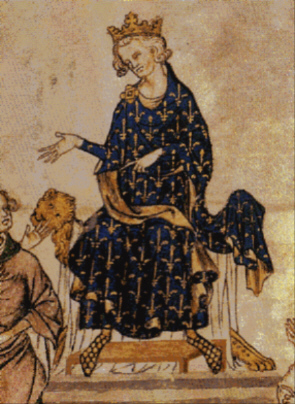
| Philippe VI of France the Fortunate @Wikipedia |
(1293-1350)
King of France
1328-1350
Husband of:
1. Jeanne de Bourgogne. (1293-1349), mar 1313, daughter of Robert II de Bourgogne & Agnes de France
2. Blanche de Navarre, mar 1350, daughter of Felipe III de Navarra & Jeanne de France.
His lover was:
1) Beatrice de La Berruere (1294-1348)
Lover in 1313.
Natural offspring:
a. Thomas de La Marche, Seigneur de La Marche (1317-1361), Lieutenant to Charles V of France, Lieutenant of Louis II of Bourbon, Governor of Auvergne, Bourbonnais, Barry & Maconnais
2. Jean d'Armagnac.

Jean II of France
the Good
(1319-1364)
King of France 1350
Son of: Philippe VI de France.
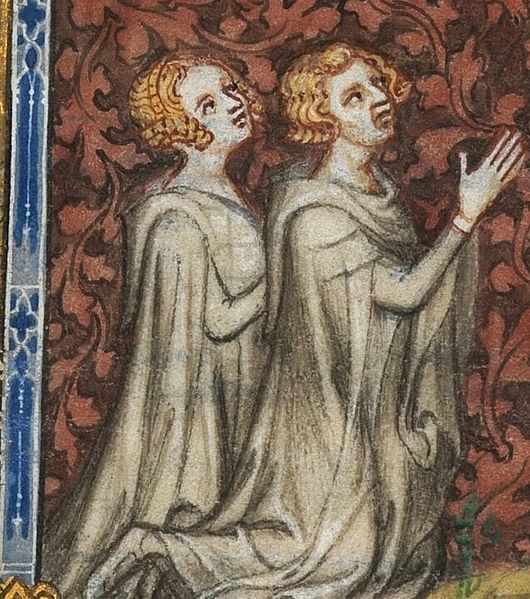 |
| Bonne of Bohemia & Jean II of France @Wikipedia |
Husband of Bonne of Bohemia (1315-1349)
Queen of France, Duchesse de Normandie, Comtesse d'Anjou & Maine
Queen of France, Duchesse de Normandie, Comtesse d'Anjou & Maine
Daughter of: Jan the Blind of Bohemia & Elisabeth of Bohemia
 |
| @Wikipedia |
Carlos de La Cerda (1327-1354)
Count of Angouleme 1350Lord of Lunel
Constable of France 1351
Son of: Alfonso de La Cerda (c1289-1327), Lord of Lunel, & Isabelle d'Antoing (1306-1354), Chatelaine of Ghent, Lady of Antoing, Epinoy and Zottegem (widow of Henri of Louvain).
Husband of: Marguerite de Blois, daughter of Charles de Blois, Duc de Bretagne, mar 1352
Daughter of: Francois Cassinel & Alips les Champs.
Isabella von Bayern, Reine de France. (1370-1435)
Abode of Venus for a notoriously promiscuous woman.
"It was essential for Henry and Philip to obtain the support and co-operation of Charles's queen, Isabeau of Bavaria, who claimed to be Regent of France. Fat and fortyish -- she had been born in 1379 -- at her court in Troyes she surrounded herself, as she had always done, with gigolos and a menagerie including leopards, cats, dogs, monkeys, swans, owls and turtle doves. Despite having given her husband twelve children she was notoriously promiscuous. Preachers rebuked her publicly to her face for making her court an 'abode of Venus'. After Agincourt the English king had told Charles of Orleans that he need not be surprised at being defeated, on account of the sensuality and vices prevalent in France -- he was referring to the court of Queen Isabeau. . . ." (The Warrior King and the Invasion of France: Henry V, Agincourt, and the Campaign that Shaped Medieval England)
First encounter -- 1385.
His lover was:
Odete de Champdivers (1384-1424)
Lover in 1407-1422.
" . . . He developed a loathing for the frivolous Isabel, and during his increasingly frequent lapses from sanity he hurled any object within reach and screamed lunatic abuse at the queen or anyone else within a convenient distance. The royal family, no more enlightened than anyone else at the time as to how to deal with mental illness, actually tried to cure the king by bringing him madwomen for company. At first the only person who could calm him during his rages was his sister-in-law, the sweet and pious Valentine, Duchess of Orleans. In later years he loved the daughter of a wig-maker, Odile de Champvilliers, who taught him to play card games, a new fad at the time, and read tarot cards; these were the only pastimes he enjoyed. Odile aline remained steadfastly close to the king unto his death thirty year later, and she bore him a daughter." (Victorious Charles: 19)
La Petite Reine.
"Odette de Champdivers, mistress of Charles, was the daughter of a dealer in horses; she was lively and engaging. The queen Isabella herself first presented her to Charles the sixth; and he soon became deeply attached to Odette. Her authority over him was so great, during his fits of frenzy, that she obtained the name of 'La Petite Reine;' under which title she is commonly known to history. The unhappy king, when seized with madness, would often persist to wear the same linen, how dirty soever; nor could any person except Odette induce him to desist from this resolution. Charles cohabited with her, and had by her a daughter named Margaret de Valois. Charles seventh having acknowledged her as his natural sister, bestowed on her a very ample portion, and gave her in marriage to the Seigneur de Belleville, in Poitou. Claude, the last of their descendants, was killed at the battle of Coutras, in 1587, under the reign of Henry III." (Wraxall: 48)
" . . . He was a low voluptuary, seeking pleasure without sentiment, and despising the sex from who he desired to obtain it. His mistresses were of inferior rank, as little to be compared with the elevated though faulty character of Agnes Sorel as Louis was to his heroic father, who freed France from the threatened yoke of England. In like manner, by selecting his favourites and ministers from among the dregs of the people, Louis showed the slight regard which he paid to eminent station and high birth; and although this might be not only excusable, but meritorious, where the monarch's fiat promoted obscure talent or called forth modest worth, it was very different when the king made his favourite associates of such men as Tristan l'Hermite, the chief of his Marshalsea or police; and it was evident that such a prince could no longer be, as his descendant Francis I elegantly designated himself, 'the first gentleman of his dominions'." (Royal Favourites, Volume 1: 169)
Louis XI's lovers were:
"From 1447 to 1456 Louis lived in (and governed) the Dauphiné. He had a relation with Phélise Regnard (d'une famille dauphinoise de petite noblesse). She was the mother of Jeanne and Marie. Michel D-D indicates that Jeanne was born in 1448 or a little later. Marie was their second child. Phélise was (subsequently?) married to Jean Pic, châtellain de Beaumont, who died already 1452. In her widowhood Phélise was known as Madame de Beaumont." (Kamp, 2003)
Personal & family background.
Phelise was the daughter of Aymar Reynard, Lord of Saint Didier.
Wife of:
1. Jean Pic (d.1452), a squire, mar 1447.
2. Charles de Seillons
Natural offspring:
a. Guyotte batarde de France (1445-1502), mar 1460 Charles de Sillons
b. Jeanne de Valois, Dame de Mirebeau (1447-1419)
Legitimized 1466
c. Marie de Valois (1449-1469) who married and was killed by Aymar de Poitiers, Seigneur de Saint-Vallier and Comte de Valentinois.
She recovered the castellany of Beaumont, confiscated in 1456, due to the king's help and kept it until her death.(Favorites de Louis XI)
"At the period of their marriage Charles IX was twenty years of age and Elizabeth sixteen; she joined to great physical advantages an amiable disposition and solid piety. Educated by virtuous parents in the principles of the most rigid morality, Elizabeth found her self isolated in the corrupt and infamous court of her husband and the queen-mother. . . ." (Memoirs of the Queens of France: 341)
Effect of infidelity on the queen.
Husband of: Marguerite de Blois, daughter of Charles de Blois, Duc de Bretagne, mar 1352
Constant companion and most trusted adviser.
"At this time King John was extremely fond of a worthy knight named Lord Charles of Spain. They'd been raised together as children, and he was his constant companion and most trusted adviser. The king granted his every wish and fancy; but he was generous and courteous towards his fellow knights and a most agreeable companion to them. King John finally appointed him Constable, and granted him land which had long been contested between the late King Philip and the King of Navarre (part of whose kingdom it was considered to be). Great resentment and hostility arose over this disputed territory, between Lord Charles of Spain and King John on one side and the young King of Navarre and his brother on the other. It wasn't long before the King of Navarre and his brother Philip had Lord Charles savagely murdered in a mighty castle at dawn: I won't tell you exactly how it was done, as I wasn't there. From that day forth, despite a series of accords and peace treaties, the two brothers of Navarre were hated by King John of France and there was constant hostility and covert conflict. He lived in permanent fear that they might assist the King of England, and indeed, it was to lead to much trouble for the kingdom of France." (The True Chronicles of Jean Le Bel, 1290-1360: 215)
"There were rumours that Philippe's successor, John II the Good, was having a relationship with Charles de La Cerda, the Constable of France, which scandal resulted in the murder of de La Cerda. . . ." (Clash of Thrones)
Plot to kill the Constable Carlos.
"About this time King John and his court were extremely disturbed by the intrigues of his young kinsman, Charles, king of Navarre. This prince, nearly connected with the French crown, his mother being a daughter of Louis X, called Hutin, possessed at once the most splendid and the most diabolical qualities. He was handsome, courageous, affable and liberal. Unfortunately he counterbalanced his good qualities by his bad ones; he was intriguing, ambitious, and capable of executing his designs by the worst means; he justly merited the title of Charles the Bad, bestowed on him by the French. Soon after the arrival of this monarch at the court of John (A.D. 1351), he rendered himself so agreeable, that he carried his point of marrying Jeanne, the daughter of the French monarch. He demanded certain places in Normandy, and when the king, to elude his importunities, conferred that country upon Charles de la Cerda, his constable and favourite, the king of Navarre did not hesitate to assassinate that unfortunate officer in his castle called de l'Aigle in Normandy. He boldly avowed the deed, put himself at the head of troops and affected independence; treated with the English for their assistance; leagued with all the fiery and discontented spirits of the court in opposition to the crown; and threatened to create such confusion, that king John felt himself under the necessity of treating with this dangerous young man instead of bringing him to justice for his crimes." (Walter Scott's History of France: 197)
Assassination of Constable Carlos de la Cerda.
"Things came to a head when Charles the Bad became King of Navarre. Charles hated his cousin, the French King John the Good (the nicknames are a clue as to who the chroniclers sided with). He was particularly outraged after John bilked him out of some land and gave it to his favorite, Charles de la Cerda, Constable of France. In 1354, a group of Navarrese mercenaries quietly surrounded the tavern where the Constable was sleeping. Charles’s brother Phillip led four troopers into the Constable’s bedroom, woke him up for some insults, and then stabbed him over 80 times. John was furious and gathered an army, but Charles began openly negotiating an alliance with the English. Unable to face both England and Navarre, John was forced to conclude a treaty with Charles. The pair continued to scheme against each other, and the quarrel badly weakened France as the English began their invasion." (Top 10 Shocking Assassinations That Changed Medieval History)
Assassination of Constable Carlos de la Cerda.
"Things came to a head when Charles the Bad became King of Navarre. Charles hated his cousin, the French King John the Good (the nicknames are a clue as to who the chroniclers sided with). He was particularly outraged after John bilked him out of some land and gave it to his favorite, Charles de la Cerda, Constable of France. In 1354, a group of Navarrese mercenaries quietly surrounded the tavern where the Constable was sleeping. Charles’s brother Phillip led four troopers into the Constable’s bedroom, woke him up for some insults, and then stabbed him over 80 times. John was furious and gathered an army, but Charles began openly negotiating an alliance with the English. Unable to face both England and Navarre, John was forced to conclude a treaty with Charles. The pair continued to scheme against each other, and the quarrel badly weakened France as the English began their invasion." (Top 10 Shocking Assassinations That Changed Medieval History)
"He took as his wife Bonne of Bohemia and fathered 11 children in eleven years. Due to his close relationship with Charles de la Cerda, rumours were spread by Charles II of Navarre of a romantic attachment between the two. La Cerda was given various honours and appointed to the high position of connetable when John became king; he accompanied the king on all his official journeys to the provinces. La Cerda's rise at court excited the jealousy of the French barons, several of whom stabbed him to death in 1354. La Cerda's fate paralleled that of Edward II of England's Piers Gaveston and John II of Castile's Alvaro de Luna; the position of a royal favourite was a dangerous one. John's grief on La Cerda's death was overt and public." (Wikipedia)
 |
| Charles V of France the Wise @Wikipedia |
His lover was:
Biette de Cassinel (1340-1380)
Lover in 1360-1380.
French royal mistress.
Biette de Cassinel (1340-1380)
Lover in 1360-1380.
French royal mistress.
Daughter of: Francois Cassinel & Alips les Champs.
 |
Charles VI of France the Mad
|
(1368-1422)
King of France 1380
Son of Charles V de France & Jeanne de Bourbon.
Husband of: Isabella von Bayern, Reine de France. (1370-1435), mar 1385
Charles VI's personal appearance & personal qualities.
"From the miniatures of the manuscripts, we know that Charles had a slightly pale face, large eyes, arched eye-brows, and a childish and smiling mouth. He was always high principles, cheerful in speech, but not given to express his feelings. This arose from his having long been under the tutelage of the constable of Clisson, the gravest knight of the Breton race." (A King's Mistress, Vol 1: 6)
"Only seventeen when they married, Charles VI was tall, blond, chivalrous, and attractive, and he had already distinguished himself as a soldier. The peace wiuth England was fragile but holding, and in spite of the rumbling and grumbling of the population over taxes, the early years of his rule promised good things. At the time of Isabel's coronation in the Sainte-Chapelle in 1389 the royal couple was hugely popular, particularly with the masses, and their progression throughout the Ile de France in the autumn of the same year gave occasion for fetes and fireworks everywhere they went. It was a promising change for the people after the severity of the plagues, famine, and wars which had marred most of the previous 150 years." (Victorious Charles: A Ladies' Man: 18)
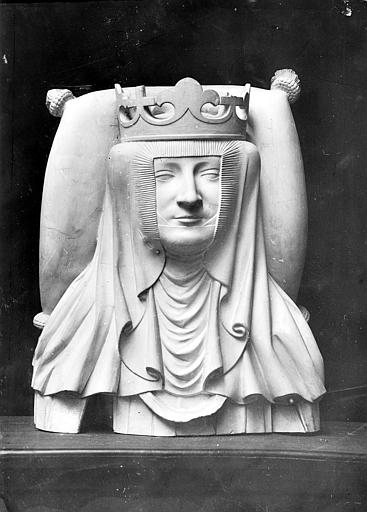 |
Isabella of Bavaria
@Wikipedia
|
An excessive lust for opulence & a special predilection for young men.
"The queen had an excessive lust for opulence in any form and she was insatiabe in every respect, a trait that increased in intensity as she grew into middle age. Having given birth to another royal child meant little more to her than the gifts she would be able to extricate from the king: another chateau, a rich abbey, or other productive domains. Queen Isabel spent money without restraint and collected everything, amassing furs, jewels, silver and gold objects, furniture, and tapestries. In her vast apartments, virtually littered with her treasures, dozens of exotic birds flew about freely, and she kept a tame leopard by her side. But her special predilection was for young men." (Victorious Charles: A Ladies' Man - a Biography of King Charles VII of France: 18)
Isabella' s physical appearance & personal qualities.
"Her beauty was something wonderful. Of more than middle height, she had blue eyes, dark eye-lashes, and, by a peculiar gift of Heaven, her hair was of a golden hue. In a miniature she is seen presented to the young King by the Duchess of Burgundy; her hair is arranged high on her head, her veil, thrown behind her, falls below her slender waist. Her dress of blue brocade comes down and touches her pointed shoes, according to the fashion of the day. Voluptuous grace breathes in her whole person. Brantome, who wrote a century later, says of Queen Isabeau of Bavaria---'She is praised for having introduced into France the grandeur and elegance of attire which lend a superb grace to ladies' dress.'" (A King's Mistress, Volume 1: 7)
"Isabel was born in Germany in 1370. Her father, Duke Stephen II of Bavaria, was a Wittelsbach prince and her mother was a Visconti from Milan. Less than five feet tall, olive skinned, and black eyed, Isabel eventually became monstrously obese to the point of being unable to walk. She was an undeterred and outrageous nymphomanian until the end of her life, and as an old woman she could be carried to her window to sit, beckoning young strangers to come up to her room and into her bed. But as a young bride of fiteen she was energetic, pretty, festive, and gay, and the beginning of her marriage to Charles VI in 1385 was a happy one. . . ." (Victorious Charles: A Ladies' Man: 18)
Abode of Venus for a notoriously promiscuous woman.
"It was essential for Henry and Philip to obtain the support and co-operation of Charles's queen, Isabeau of Bavaria, who claimed to be Regent of France. Fat and fortyish -- she had been born in 1379 -- at her court in Troyes she surrounded herself, as she had always done, with gigolos and a menagerie including leopards, cats, dogs, monkeys, swans, owls and turtle doves. Despite having given her husband twelve children she was notoriously promiscuous. Preachers rebuked her publicly to her face for making her court an 'abode of Venus'. After Agincourt the English king had told Charles of Orleans that he need not be surprised at being defeated, on account of the sensuality and vices prevalent in France -- he was referring to the court of Queen Isabeau. . . ." (The Warrior King and the Invasion of France: Henry V, Agincourt, and the Campaign that Shaped Medieval England)
First encounter -- 1385.
" . . . She had been brought to Amiens on a pilgrimage by Duke Frederick of Bavaria. King Charles VI had seen her as she knelt before the Virgin: he had fallen hopelessly in love with her, and their nuptials were celebrated with great pomp in the Cathedral of Amiens." (A King's Mistress, Vol. 1: 7)
Rumours & calumny against the Queen.
"On the other hand, it was said that the Queen, the lovely and coquettish Isabelle of Bavaria, forgot the poor King amidst pleasures and dances, in her palace at the corner of the old Rue du Temple and of the Rue Barbette, which she had just purchased. There she gave receptions to the Dukes d'Orleans and their gayest companions. It was in fact a Court quite separate and distinct from that of the Tournelles of the old Louvre. The strangest rumours were abroad concerning the Queen's behaviour; we must, however, remember that at this time the country was in the midst of civil war and that the Burgundians and Armagnacs hated each other cordially. Now, the favourite weapon of partisans is calumny." (A King's Mistress, Vol. 1: 15)
Rumours & calumny against the Queen.
"On the other hand, it was said that the Queen, the lovely and coquettish Isabelle of Bavaria, forgot the poor King amidst pleasures and dances, in her palace at the corner of the old Rue du Temple and of the Rue Barbette, which she had just purchased. There she gave receptions to the Dukes d'Orleans and their gayest companions. It was in fact a Court quite separate and distinct from that of the Tournelles of the old Louvre. The strangest rumours were abroad concerning the Queen's behaviour; we must, however, remember that at this time the country was in the midst of civil war and that the Burgundians and Armagnacs hated each other cordially. Now, the favourite weapon of partisans is calumny." (A King's Mistress, Vol. 1: 15)
.jpg) |
| Odete de Champdivers Royal mistress the Little Queen |
Odete de Champdivers (1384-1424)
Lover in 1407-1422.
" . . . He refused to see his Queen Isabella, his uncles or his children, and declined all nourishment as if it had been poisoned. To distract his thoughts, they brought him some loose women; one only of their number, a young girl who waited on the King, was able to acquire a gentle ascendancy over him. Her name was Odette de Champvillers. Her father was a horse-trader and frequently came to the Louvre on business. The King had conceived such a love for her that he obeyed her caprices, like a child obeys the laws of a master. Charles VI was twenty-five years old, Odette seventeen. She played on the lute, and knew the tales and stories of chivalry. Surrounded by images and illuminated manuscripts, Odette taught the King the games of cards and Pope Joan, which Jacquemin Gringoneur, a painter and illuminator of Paris, presented to him. . . ." (A King's Mistress, Volume 1: 14)
" . . . He developed a loathing for the frivolous Isabel, and during his increasingly frequent lapses from sanity he hurled any object within reach and screamed lunatic abuse at the queen or anyone else within a convenient distance. The royal family, no more enlightened than anyone else at the time as to how to deal with mental illness, actually tried to cure the king by bringing him madwomen for company. At first the only person who could calm him during his rages was his sister-in-law, the sweet and pious Valentine, Duchess of Orleans. In later years he loved the daughter of a wig-maker, Odile de Champvilliers, who taught him to play card games, a new fad at the time, and read tarot cards; these were the only pastimes he enjoyed. Odile aline remained steadfastly close to the king unto his death thirty year later, and she bore him a daughter." (Victorious Charles: 19)
La Petite Reine.
"Odette de Champdivers, mistress of Charles, was the daughter of a dealer in horses; she was lively and engaging. The queen Isabella herself first presented her to Charles the sixth; and he soon became deeply attached to Odette. Her authority over him was so great, during his fits of frenzy, that she obtained the name of 'La Petite Reine;' under which title she is commonly known to history. The unhappy king, when seized with madness, would often persist to wear the same linen, how dirty soever; nor could any person except Odette induce him to desist from this resolution. Charles cohabited with her, and had by her a daughter named Margaret de Valois. Charles seventh having acknowledged her as his natural sister, bestowed on her a very ample portion, and gave her in marriage to the Seigneur de Belleville, in Poitou. Claude, the last of their descendants, was killed at the battle of Coutras, in 1587, under the reign of Henry III." (Wraxall: 48)
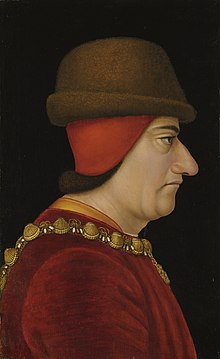 |
Louis XI of France the Universal Spider
|
" . . . The Dauphine . . . was a jumble of feudal and episcopal entities. Louis arrived in January of 1447 and transformed the little province into a state, doubled its size and centralized its governance. He gloried in being away from his father's control and having the personal life he aspired to. He took his mistresses, rode incessantly on horseback, and ate and drank to his heart's content all the while gaining followers." (The Freelance History Writer)
" . . . He was a low voluptuary, seeking pleasure without sentiment, and despising the sex from who he desired to obtain it. His mistresses were of inferior rank, as little to be compared with the elevated though faulty character of Agnes Sorel as Louis was to his heroic father, who freed France from the threatened yoke of England. In like manner, by selecting his favourites and ministers from among the dregs of the people, Louis showed the slight regard which he paid to eminent station and high birth; and although this might be not only excusable, but meritorious, where the monarch's fiat promoted obscure talent or called forth modest worth, it was very different when the king made his favourite associates of such men as Tristan l'Hermite, the chief of his Marshalsea or police; and it was evident that such a prince could no longer be, as his descendant Francis I elegantly designated himself, 'the first gentleman of his dominions'." (Royal Favourites, Volume 1: 169)
Louis XI's lovers were:
 |
| Marguerite de Sassenage |
1) Marguerite de Sassenage (1449-1471)
Dame de Beaumont
Daughter of: Henri II "the Red" (1384-?), Lord of Sassenage, and of Antonia di Saluzzo. They a daughter Isabeau de Valois who was married to Louis Richard de Saint-Priest.
Wife of: Amblard de Beaumont, Seigneur de Montfort.
Natural offspring:
a. Isabelle de France who married Louis de Saint-Priest [Fam1]
2) Phelise Regnard (c1424-1474).
Lover in 1442-1456.
Dame de Beaumont
Daughter of: Henri II "the Red" (1384-?), Lord of Sassenage, and of Antonia di Saluzzo. They a daughter Isabeau de Valois who was married to Louis Richard de Saint-Priest.
Wife of: Amblard de Beaumont, Seigneur de Montfort.
Natural offspring:
a. Isabelle de France who married Louis de Saint-Priest [Fam1]
2) Phelise Regnard (c1424-1474).
Lover in 1442-1456.
Legitimized 1465
Chatelaine de Beaumont-en-Trieves, 1452-1456
Châtellaine de La Mure in Mathésine, 1461-1463
1st mistress of Louis XI of France when he was the Crown Prince of France
Châtellaine de La Mure in Mathésine, 1461-1463
1st mistress of Louis XI of France when he was the Crown Prince of France
"From 1447 to 1456 Louis lived in (and governed) the Dauphiné. He had a relation with Phélise Regnard (d'une famille dauphinoise de petite noblesse). She was the mother of Jeanne and Marie. Michel D-D indicates that Jeanne was born in 1448 or a little later. Marie was their second child. Phélise was (subsequently?) married to Jean Pic, châtellain de Beaumont, who died already 1452. In her widowhood Phélise was known as Madame de Beaumont." (Kamp, 2003)
Personal & family background.
Phelise was the daughter of Aymar Reynard, Lord of Saint Didier.
Wife of:
1. Jean Pic (d.1452), a squire, mar 1447.
2. Charles de Seillons
Natural offspring:
a. Guyotte batarde de France (1445-1502), mar 1460 Charles de Sillons
b. Jeanne de Valois, Dame de Mirebeau (1447-1419)
Legitimized 1466
Wife of Louis batard de Bourbon, 1st Comte de Rousillon and Admiral of France, mar 1465
c. Marie de Valois (1449-1469) who married and was killed by Aymar de Poitiers, Seigneur de Saint-Vallier and Comte de Valentinois.
She recovered the castellany of Beaumont, confiscated in 1456, due to the king's help and kept it until her death.(Favorites de Louis XI)
 |
| Charles IX of France @Wikipedia |
(1550-1574)
King of France
1560-1574
Son of: Henri II de France & Catherine de' Medici
Husband of: Elisabeth von Osterreich, mar 1570.
Physical appearance & personal qualities.
"Charles IX was tall and slim, feeble and sickly. His eyes were glassy and without speculation til he became excited, when they flashed like fire. He wore his hair long, and flowing over his shoulders. In disposition he was indolent, and without moral courage. His mother could sway him as she liked, and overcome all his scruples without difficulty. He was fond of poetry, and wished to be considered a poet himself. His favourite author was Ronsard. In the chase, he became excited almost to madness. He followed the wild boar with perfect fury, blowing his horn till his eyes were blood-shot, and encountering the greatest danger with foolhardy recklessness. Like his father and brother Henry, he was passionately fond of dogs, with which his apartments were filled. . . He dressed in the Venetian style, with huge rosettes in his shoes, at his knees, and at his wrists; a large raff round his neck, ; and a plumed had." (The Political, Social, and Literary History of France: 162)
"In stature Charles was tall, his shoulders were high, and he had a slight habitual stoop. His features were well formed and intelligent, though pallid. His eyes were sharp and penetrating, deeply set, and shadowed by heavy brows. . . ." (Henry III King of France and Poland: 35)
Husband of: Elisabeth von Osterreich. mar 1570.
 |
| Elisabeth of Austria Queen of France @Wikipedia |
"At the period of their marriage Charles IX was twenty years of age and Elizabeth sixteen; she joined to great physical advantages an amiable disposition and solid piety. Educated by virtuous parents in the principles of the most rigid morality, Elizabeth found her self isolated in the corrupt and infamous court of her husband and the queen-mother. . . ." (Memoirs of the Queens of France: 341)
Effect of infidelity on the queen.
"Elizabeth, his consort, and daughter of the Emperor Maximilian, was good, sensible, and pious; but though respected by the king, she was very unhappy. The profligate court was a scene shocking to her piety and purity, and she lived in it, but not of it, a very solitary life; seldom speaking, and then only in Spanish, her vernacular tongue. Though she bore meekly with the mistresses whom her husband paraded before her, she was deeply hurt by his infidelities. Charles, on his death-bed, confessed himself unworthy of so amiable a wife, and regretted the sorrows he had caused her; sorrows which left such enduring traces on her mind, that though young, when widowed, she retired into a perfect seclusion, refusing the proferred alliances of the kings of Spain and Portugal, and founded at Vienna a convent, in which she devoted herself to religious exercises until her death at the age of thirty" (The Eclectic Magazine of Foreign Literature, Science, and Art, Vol 29: 67)
Charles IX of France's lovers were:
1) Helena Bon de Mes-guillon.
" . . . Before his marriage the king had formed an attachment for Helena Bon de Mes-guillon, daughter of the governor of Marseilles, and wife of Charles de Gondi de la Tour, grand master of the wardrobe, who, urged by jealousy, endeavoured to poison the king, but was prevented by his wife. It is said that Madame de Gondi, to revenge this attempt, retaliated in the same manner upon her husband, and with success. Nevertheless, after the massacres of St. Bartholomew, in which Madame de Gondi lost a near relation, she coldly replied to the king's letters: when sought by him in person she was seized in an involuntary terror, which she could bot repress at the sight of him; and to avoid his attentions retired to the convent of St. Magloire, where she obtained absolution from her brother-in-law, Peter de Gondi, archbishop of Paris." (Memoirs of the Queens of France: 343)
2) Marie Touchet (1549-1638).
Charles IX of France's lovers were:
1) Helena Bon de Mes-guillon.
" . . . Before his marriage the king had formed an attachment for Helena Bon de Mes-guillon, daughter of the governor of Marseilles, and wife of Charles de Gondi de la Tour, grand master of the wardrobe, who, urged by jealousy, endeavoured to poison the king, but was prevented by his wife. It is said that Madame de Gondi, to revenge this attempt, retaliated in the same manner upon her husband, and with success. Nevertheless, after the massacres of St. Bartholomew, in which Madame de Gondi lost a near relation, she coldly replied to the king's letters: when sought by him in person she was seized in an involuntary terror, which she could bot repress at the sight of him; and to avoid his attentions retired to the convent of St. Magloire, where she obtained absolution from her brother-in-law, Peter de Gondi, archbishop of Paris." (Memoirs of the Queens of France: 343)
 |
Marie Touchet
|
Lover in 1572.
Comtesse d'Entragues; Dame de Belleville.
Physical appearance & personal qualities.
"Charles afterwards [after Helena Bon de Mes-guillon] attached himself to Marie Touchet, daughter of a judge of Orleans and of Marie Mathy. She was born at Gien in 1549, and received a brilliant education from her father, who was exceedingly clever. To the charms of agreeable conversation she added those of person, and nothing could more exactly describe her than the anagram of her name, Marie Touchet: ie charme tout.'"(Memoirs of the Queens of France: 343)
First encounter with the king.
"At the period when Charles IX first beheld Marie the court resided at Blois, so that the near neighbourhood of Orleans, and the king's numerous excursions, afforded him many opportunities of seeing the young Orleannaise. For some time he magnanimously stifled his passion, but, not finding in the object of it an equally disinterested auxiliary, he abandoned himself to its power, and Marie responded, or feigned to respond, to his attachment." (Memoirs of the Queens of France: 343)
" . . . Marie Touchet, Comtesse d'Entragues . . . obtained permission to see his Majesty dine in public, where her extreme beauty so impressed the Monarch that he inquired her name, and at the close of the repast despatched M. de Latour, the master of his wardrobe, to desire her attendance in his closet. The negotiation did not prove a difficult one; as the lady, although at the moment strongly attached to M. de Monluc, the brother of the Bishop of Valence, could not resist the prestige of royalty. . . ." (The Life of Marie de Medicis: 284)
" . . . Charles IX and Marie Touchet began their relationship before 1570, the year of the king's marriage to Elizabeth of Austria; in 1573 Marie bore him a child, Charles, later duc d'Angouleme." (The Wrightsman Pictures: 21)
Marie's other liaison.
"Marie is accused of having formed a liaison with Monsieur de Montluc, brother of the archbishop of Valence, of which the king was informed; accordingly, when at supper, Charles took the reticule of his favourite, under pretext of admiring the tissue, and discovered in it a billet which she had received from that gentleman. Marie immediately threw herself at the king's feet, and succeeded in obtaining his pardon. Charles IX's affection for Marie Touchet never ceased but with his life, and in his last moments he charged Monsieur de la Tour to recommend her to the protection of the queen-mother." (Memoirs of the Queens of France: 344)
Marie's spouse & children.
"At the death of his wife, Jacqueline de Rohan, the lord of Balsac d'Entraigues married Marie Touchet, in 1578, and had two daughters by her, Henrietta, marquise de Verneuil, and Marie, who lived for ten years with the marshal de Bassompierre. After her marriage Madame d'Entraigues became strict in her principles of morality, having, it is said, killed with her own hands one of her pages who attempted some liberties with her youngest daughter; nevertheless, she and her husband suffered the eldest to become the mistress of Henry IV for a promise of marriage upon certain conditions, and the sum of one hundred thousand crowns." (Memoirs of the Queens of France: 345)
Marie's natural offspring with Charles IX.
"Marie Touchet was the daughter of an apothecary of Orleans. She bore king Charles two sons---the eldest died in his infancy; the second, Charles de Valois, lived to become grand prior of France, duc d'Angouleme, and to espouse a Montmorency. Marie Touchet, after the decease of king Charles, married Francois Balsac d'Antragues, in 1578, and became the mother, besides other children, of Henriette marquise de Verneuil, mistress of Henry IV. The comtesse d'Entragues died in 1587, of fright, during a popular commotion in Orleans." (Henry III King of France and Poland: 35)
Affair's end & aftermath.
"She was twenty-five years of age when his death occurred, but the event did not change her position at court, for she had been bountifully enriched by Charles, and the indifference she had always manifested for state affairs had gained her the attachment of Catherine de' Medicis, who beheld her there without suspicion." (Memoirs of the Queens of France: 345)