 |
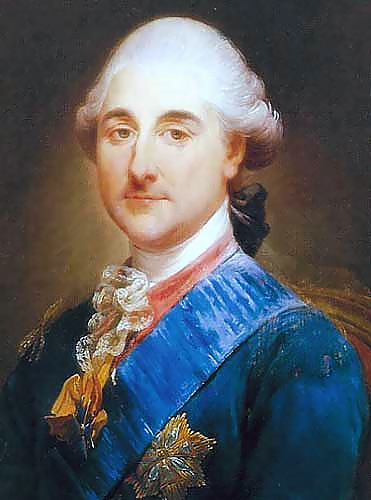
| Stanislaw II August of Poland |
"Stanislaw-August Poniatowski (r. 1764-1795), the last king-grand duke of Poland-Lithuania, was the Familia's candidate for the throne and a former lover of the Russian empress, Catherine the Great. As a young diplomat employed in St. Petersburg by both the British and the Saxon embassies, he had made a huge impression on the German-born future empress, who selected him for protracted romantic services. A decade later, he easily won her support in the royal election. As monarch, however, he saw his task as one of urgent reform, reanimating the vital organs of the moribund state, modernizing society, promoting culture and relaxing the stranglehold of the pro-Russia magnates elevated by his Saxon predecessors. The empress wished to maintain the status quo from which Russia greatly benefited. The two of them were on a collision course. Every time the beleaguered monarch showed signs of pulling his country from the quagmire, his patroness pushed it back in." (Vanished Kingdoms: The History of Half-Forgotten Europe: lxii)
 | |
|
Physical appearance & personal qualities.
" . . . Tall and well made, his movements were graceful, while his face was singularly handsome, not alone because of its delicately cut features, clean pallid complexion, and blue-black hair, but because of his deep grey eyes which in reposed had an expression of tender melancholy that more than all else won his way to women's hearts. Added to this he spoke many languages in a voice of singular sweetness, he danced to perfection, was a master in the art of compliments, and possessed a natural fascination over all with whom he came in contact. . . ." (The Russian Court in the Eighteenth Century: 151)
" . . . Tall and well made, his movements were graceful, while his face was singularly handsome, not alone because of its delicately cut features, clean pallid complexion, and blue-black hair, but because of his deep grey eyes which in reposed had an expression of tender melancholy that more than all else won his way to women's hearts. Added to this he spoke many languages in a voice of singular sweetness, he danced to perfection, was a master in the art of compliments, and possessed a natural fascination over all with whom he came in contact. . . ." (The Russian Court in the Eighteenth Century: 151)
The beauties of Poland & their brilliant Prince Charming.
"By nature, then, Stanislaus II was the least heroic of men, and the luxurious atmosphere which he breathed, habitually and by preference, was not conducive to the cultivation of the robuster virtues. From the moment of his elevation to the throne all the errant and acquisitive Beauties of Poland were as irresistibly attracted to this brilliant Prince Charming as moths are attracted by the light of a candle set upon a lofty pedestal. In this instance, however, it was not the moths, but the candle, which suffered the most." (The last king of Poland and his contemporaries: 93)
The best foreign description of King Stanislaw.
"Of the numerous foreign descriptions of Stanislaus, the best, on the whole, is that of the Swedish Minister Lars von Engestrom. It is particularly interesting as a picture of Stanislaus when he was beginning to grow old. '" The King of Poland has the most beautiful head I ever saw, but an expression of extreme sadness somewhat diminished the beauty of his face. He did not look happy and his hair was already beginning to grow grey. He was broad-shouldered, with a deep chest, and tall with relatively short legs. He had had a splendid constitution, but trouble and his mode of life had undermined it. At this time he was often ailing, and fears were even entertained of his life. ... He possessed all the brilliant qualities necessary to sustain his exalted position with dignity. ... He could speak Polish, Latin, German, Italian, French and English perfectly. His conversation always excited the admiration of foreigners, and he was thoroughly au fait with all the literary and artistic novelties of the day. As a master of the ceremonies he would have done infinite honour to the most brilliant of Courts. He had correspondents everywhere whom he paid most handsomely, and was, certainly, one of the best informed of Princes as to the course of European affairs."' (The last king of Poland and his contemporaries: 124)
His lovers were:
"Chajka (Czajka) (d. after 14 November 1781), daughter of Lithuanian merchant Abramek Lwowski, mistress of Polish king Stanisław August Poniatowski. She was Jewish. She lived in Żwaniec. In 1781 she was portrayed by Krzysztof Radzwiłłowski. She had a daughter named Elia (Ella)." (Wikipedia)
Wife of:
1. Jan Jerzy Grabowski (d.1789), Polish noble & general, mar 1769
2. Stanisław August Poniatowski, morganatic mar 1789?

Lover in 1765-1778.
Italian ballerina & royal mistress
Wife of Italian adventurer Carlo Alessandro Tomatis (1739-1797)
 |
| Chajka @Wikipedia |
2) Chajka
Lover in 1770's.
 |
| Elizabeth, Countess Sapieha 1770s @Wikipedia |
3. Elzbieta Branicka (1734-1800)
Lover in 1763-1776.
Daughter of Piotr Branicki and Melania Teresa Szembek.
Wife of:
1. Jan Józef Sapieha, Voivode of Smolensk, mar 1753, div 1755.
2. Jan Sapieha (d.1757), a relative of her 1st husband, mar 1755.
"Elżbieta Branicka was not regarded a beauty, but described as a fascinating and charming woman, intelligent and with a great interest in politics. In 1761, she became an ally of Stanisław August Poniatowski, and gave him a loan of 300.000 zlotys, with a great interest, to fund his political career: he was still paying of the debt six year later. During the interregnum of 1763-64, they reportedly begun an affair, and she influenced him against the Czartoryski family. She was the rival of Magdalena Agnieszka Sapieżyna, who in contrast to her supported the Familia (political party) and in parallel attempted to influence Poniatowski in favor of it. When Poniatowski was elected king, Branicka came to be in a very powerful position." (Wikipedia)
2. Jan Sapieha (d.1757), a relative of her 1st husband, mar 1755.
"Elżbieta Branicka was not regarded a beauty, but described as a fascinating and charming woman, intelligent and with a great interest in politics. In 1761, she became an ally of Stanisław August Poniatowski, and gave him a loan of 300.000 zlotys, with a great interest, to fund his political career: he was still paying of the debt six year later. During the interregnum of 1763-64, they reportedly begun an affair, and she influenced him against the Czartoryski family. She was the rival of Magdalena Agnieszka Sapieżyna, who in contrast to her supported the Familia (political party) and in parallel attempted to influence Poniatowski in favor of it. When Poniatowski was elected king, Branicka came to be in a very powerful position." (Wikipedia)
 |
| Elzbieta Szydlowska c1790 @Wikipedia |
4) Elzbieta Szydlowska (1748-1810)
Lover in 1789-1798
Lover in 1789-1798
Daughter of Teodor Szydłowski, Voivode of Plock & Teresa Witkowska.
Wife of:
1. Jan Jerzy Grabowski (d.1789), Polish noble & general, mar 1769
2. Stanisław August Poniatowski, morganatic mar 1789?
Natural offspring.
1. Stanislaw Konopnicy-Grabowski (1780-1845)
2. Michal Grabowski (1773-1812)
3. Kazimierz Grabowski (1770-?)
4. Konstancja Grabowska
5. Izabela Grabowska (1756-1858)
"A few historians believe that he later contracted a secret marriage with Elżbieta Szydłowska. However, according to Wirydianna Fiszerowa, a contemporary who knew them both, this rumour only spread after the death of Poniatowski, was generally disbelieved, and moreover, was circulated by Elżbieta herself, so the marriage is considered by most to be unlikely. . . ." (Wikipedia)
"In 1789, she became a widow and possibly entered into a secret, morganatic marriage with the King, remaining known at court as his maîtresse-en-titre. However, Wirydianna Fiszerowa, a contemporary who knew her, reported that tales of this marriage only circulated after Poniatowski's death, and were spread about by Elżbieta herself, but were not generally believed. She was thought to have exercised some influence on the king during his reign perceived as negative, which made her unpopular. In 1795, King Stanisław abdicated following the Third Partition of Poland, and lived in Grodno under Russian watch until, in 1796, Paul I of Russia invited him to Saint Petersburg. Elżbieta, with her two sons, Stanisław and Michał, took the king to Saint Petersburg to care for him there, and she lived with him until his sudden death in 1798. Afterwards, she returned to Warsaw, then under Prussian rule following the Partitions, where she became a patroness of the Tableau vivant there. She died in Warsaw on 1 June 1810, survived by four of her children." (Famous Fix)
"In 1789, she became a widow and possibly entered into a secret, morganatic marriage with the King, remaining known at court as his maîtresse-en-titre. However, Wirydianna Fiszerowa, a contemporary who knew her, reported that tales of this marriage only circulated after Poniatowski's death, and were spread about by Elżbieta herself, but were not generally believed. She was thought to have exercised some influence on the king during his reign perceived as negative, which made her unpopular. In 1795, King Stanisław abdicated following the Third Partition of Poland, and lived in Grodno under Russian watch until, in 1796, Paul I of Russia invited him to Saint Petersburg. Elżbieta, with her two sons, Stanisław and Michał, took the king to Saint Petersburg to care for him there, and she lived with him until his sudden death in 1798. Afterwards, she returned to Warsaw, then under Prussian rule following the Partitions, where she became a patroness of the Tableau vivant there. She died in Warsaw on 1 June 1810, survived by four of her children." (Famous Fix)
" . . . The most stable of his liaisons were those with Madame de Lulli and Pani Grabowska. . . Pani Grabowska, subsequently the King's morganatic wife, was an amiable blonde "with heavenly eyes," and a skin of a whiteness rare even in Poland. She was the only sweetheart of Stanislaus who was sincerely attached to him. She asked nothing from him either for herself or for his good and ill fortune and was always ready with salutary and disinterested advice. The King's intercourse with her began during her husband's lifetime. He would have married her privately there and then, but his chaplain refused to perform the ceremony till the lady had become a widow. They were finally wedded, late at night, in the royal chapel, Grabowska's brother and the Primate of Poland being the sole witnesses. After his marriage with Grabowska the King led a much more regular life ; renounced all " les mitres et elites," and gave himself up almost entirely to affairs of State. Of his still earlier relations with the Princess Sapiezhna, already mentioned, Elizabeth Rozhanka, and the actress " Todi," who enchanted him with her beautiful voice, it is unnecessary to speak. The usual rendezvous was the studio of the artist Bacciarelli where a great court-lady, Pani Malczewska, used to go through her celebrated " mythological poses," au naturel. er friends. She never intrigued or plotted against him. She shared with him both." (The last king of Poland and his contemporaries: 126)
5. Henrietta Lullier (1716 - 1802).
French fortuneteller
Lover in 1753.
Wife of Augustus Louis Lullier
"Henrietta Zofia Puszet Lullier (1716 - 1802, Warsaw), was a French fortune teller. She was the influential favorite of king Stanislaw August Poniatowski of Poland and his brother Kazimierz Poniatowski. In 1753, she was the mistress of Stanislaw August Poniatowski during his visit to Paris. In 1754, she married Augustus Louis Lullier, who was employed in the court of Augustus III of Poland, and settled with him in Poland. She resumed her contact with Poniatowski, who was elected king of Poland. In 1765, the king's brother bought her a house; she was also a diplomatic agent to the Russian diplomat Nicholas Repnin and the Prussian diplomat Gedeon Benoit." (Company of the Electromechanical Factories of Constructions)
" . . . It is impossible to observe a chronological sequence in the innumerable amours of Stanislaus Augustus. The most stable of his liaisons were those with
Madame de Lulli and Pani Grabowska. The former was a French emigree Marquise of great charm and beauty. At the age of eighteen she accompanied her aunt to Warsaw and soon acquired such an absolute dominion over the King that she interfered in affairs of State and became a source of emolument and promotion to which many had recourse. She lived in the Cracow suburb, and her equipages and her diamonds were the admiration of the Polish capital. Every penny of the millions, which she banked securely abroad, came out of the King's pocket. . . ." (The last king of Poland and his contemporaries: 126)
Lover in 1753.
Wife of Augustus Louis Lullier
"Henrietta Zofia Puszet Lullier (1716 - 1802, Warsaw), was a French fortune teller. She was the influential favorite of king Stanislaw August Poniatowski of Poland and his brother Kazimierz Poniatowski. In 1753, she was the mistress of Stanislaw August Poniatowski during his visit to Paris. In 1754, she married Augustus Louis Lullier, who was employed in the court of Augustus III of Poland, and settled with him in Poland. She resumed her contact with Poniatowski, who was elected king of Poland. In 1765, the king's brother bought her a house; she was also a diplomatic agent to the Russian diplomat Nicholas Repnin and the Prussian diplomat Gedeon Benoit." (Company of the Electromechanical Factories of Constructions)
" . . . It is impossible to observe a chronological sequence in the innumerable amours of Stanislaus Augustus. The most stable of his liaisons were those with
Madame de Lulli and Pani Grabowska. The former was a French emigree Marquise of great charm and beauty. At the age of eighteen she accompanied her aunt to Warsaw and soon acquired such an absolute dominion over the King that she interfered in affairs of State and became a source of emolument and promotion to which many had recourse. She lived in the Cracow suburb, and her equipages and her diamonds were the admiration of the Polish capital. Every penny of the millions, which she banked securely abroad, came out of the King's pocket. . . ." (The last king of Poland and his contemporaries: 126)
 |
| Magdalena Sapiezyna @Wikipedia |
Wife of:
1. Józef Lubomirski (d.1755?), mar 1755
2. Aleksander Michał Sapieha, mar 1756.
2. Aleksander Michał Sapieha, mar 1756.
Natural Offspring
a. Konstancja Zwanowa (1768-1810), born Konstancja Cichocki
b. Michal Cichocki (1770-1828), Brigadier General of Duchy of Warsaw.
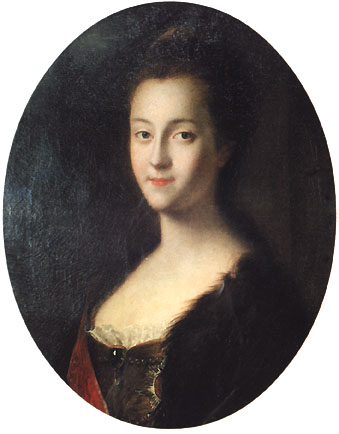 |
| Catherine of Russia 1745 @Wikipedia |
Lover in 1755-1758.
Natural offspring. Anna Petrovna (17?5-1758)
"Stanislaus Poniatowski, three years younger than Catherine, could not compete in male beauty with Sergei Saltykov. He was short, his face heart-shaped, his eyes shortsighted and hazel. He had prominent eyebrows and a tapering chin, but he spoke six languages, his charm and conversation made him welcome everywhere, and, at twenty-three, he was a model of the young, sophisticated European aristocrat... Two qualities, however, Stanislaus lacked. There was little originality and no real gravitas in this young Pole, deficiencies that Catherine came to recognize and accept...." (Catherine the Great: Portrait of a Woman: 183)
"Stanislaus Poniatowski, three years younger than Catherine, could not compete in male beauty with Sergei Saltykov. He was short, his face heart-shaped, his eyes shortsighted and hazel. He had prominent eyebrows and a tapering chin, but he spoke six languages, his charm and conversation made him welcome everywhere, and, at twenty-three, he was a model of the young, sophisticated European aristocrat... Two qualities, however, Stanislaus lacked. There was little originality and no real gravitas in this young Pole, deficiencies that Catherine came to recognize and accept...." (Catherine the Great: Portrait of a Woman: 183)
"England sent a new Ambassador, Sir Charles Hanbury-Williams to St. Petersburg. In his entourage was a charming and cultured young man, Count Stanislav Augustus Poniatowski, a member of Poland's grand families, the Czartoryskis. Three years younger than Catherine, he fell in love with the young Grand Duchess and would love her all his life. Catherine was more levelheaded after the affair with her first love, but succumbed to his persistent charm. The affair lasted five years and produced Catherine's second child, a girl, whom the Empress called Anna in honor of her late sister, the mother of Catherine's husband. Anna died at age 2 in 1759." (Catherine the Great FAQ)
"On 29 June [1755] a supper to which all the ambassadors and foreign ministers were invited took place at Oranienbau, in celebration of the Grand Duke's name-day. Catherine was seated next to the British ambassador, Sir Charles Hanbury-Williams, whom she had first met some months earlier. . . On this occasion, Sir Charles was accompanied for the first time by his young Polish secretary, Stanislas Poniatowski, who immediately attracted Catherine's attention as she and Sir Charles watched him dance. . . Twenty-two years old and still a virgin, he was ready to throw himself into a love affair with passion, as was Catherine. . . By the summer of 1756 Catherine was deeply involved with Stanislas Poniatowski, both physically and emotionally. Theirs was a sentimental relationship, in keeping with both their youth and with the sensibility of the age in which they lived. . . [S]he abandoned herself to this romantic attachment. This was the first time in her life she had found a man fully responsive to both her sexual and emotional needs, and she was prepared to take many risks in order to spend as much time with him as she could. . . ." (Catherine the Great: Love, Sex, and Power)
"England sent a new Ambassador, Sir Charles Hanbury-Williams to St. Petersburg. In his entourage was a charming and cultured young man, Count Stanislav Augustus Poniatowski, a member of Poland's grand families, the Czartoryskis. Three years younger than Catherine, he fell in love with the young Grand Duchess and would love her all his life. Catherine was more levelheaded after the affair with her first love, but succumbed to his persistent charm. The affair lasted five years and produced Catherine's second child, a girl, whom the Empress called Anna in honor of her late sister, the mother of Catherine's husband. Anna died at age 2 in 1759." (Catherine the Great FAQ)
Other mistresses:
Dalilka Ciecierzynika
Elizabeth Rozhanska
Todi
Jadwiga Strutynska