
King of England
1100-1135
Duke of Normandy
1106-1135
Son of: William the conqueror & Matilda of Flanders.
Husband of:
1. Matilda of Scotland
Daughter of Malcolm Canmore, King of Scots & St. Margaret of England.
2. Adelicia of Louvain.
Henry I's physical appearance & personal qualities.
" . . . The historian William of Malmesbury leaves us with a contemporary description: 'He was of middle stature, his hair was black, but scanty near the forehead; his eyes were mildly bright, his chest brawny, his body well fleshed. He was facetious in proper season, nor did multiplicity of business cause him to be less pleasant when he mixed in society. Not prone to personal combat, he verified the saying of Scipio Africanus, 'My mother bore me a commander not a soldier.' wherefore he was inferior in wisdom to no king of modern time; and I may also say, he clearly surpassed all his predecessors in England and preferred contending by counsel, rather than by the sword. If he could he conquered without bloodshed; it it was unavoidable, with little as possible.'" (English Monarchs)
Seldom faithful to his queen; a serial adulterer.
' . . . Though Henry was seldom faithful to his Queen, theirs was generally considered a good and happy marriage by royal standards and helped to unite the rival claims of the Norman and Saxon houses. . . Henry proved to be a serial adulterer and begat more illegitimate children than any other English King; in all he fathered twenty bastards, by a continuous string of mistresses. One of these was the beautiful Nesta, Princess of Wales, who became the mother of the King's son, Henry. BY far the most famous of Henry's illegitimate offspring was Robert of Caen, later created Earl of Gloucester, he was born in 1090, by a Norman mother, before Henry came to the English throne and was later to play a leading part on the stage of English history. Sybil, his daughter by Sybil Corbet, who was born in the 1090's was married to Alexander 'the Fierce', King of Scots, the brother of Henry's Queen, Edith." (English Monarchs)
Summary of Henry I's known mistresses & illegitimate children.
"But, besides settling the affairs of his Church and realm, Henry had other more distinctly domestic and personal duties to discharge. He had to reform the household which he had inherited from his brother; he had also---so we are told that the bishops and others strongly pressed upon him---to reform his own life. The vices of Henry were at least not the vices of Rufus; inclination as well as duty led him to cleanse the court of its foulest abuses, to make a clean sweep of the works of darkness. But it was only in a wholly abnormal state of things that Henry the First would have been hailed as a moral reformer. His private life was very unlike the life of his father. Unmarried, like both of his brothers till the recent marriage of Robert, he was already the father of several children by mothers of various nations. Of his eldest and most famous son, Robert, afterwards the renowned Earl of Gloucester, the mother is unknown; but she appears to have been French. The British Nest, of whom we have often heard, the daughter of Rhys ap Tewdwr, had, before her marriage with Gerald of Windsor, borne a son to Henry who bore his own name. Two of his mistresses bore the characteristic name of Eadgyth. One was the mother of Matilda Countess of Perche, who died in the White Ship; the other, who afterwards, like Nest obtained an honourable marriage with the younger Robert of Ouilly, was the mother of a Robert who plays a part in the civil wars forty years later. His birth therefore most likely came long after the times of which we are speaking, as did the birth of the daughter whom Henry is said to have had by a woman of a Norman house of the loftiest rank, Isabel, daughter of his chief counsellor, Robert Count of Meulan and Earl of Leicester. The list of Henry's natural children is not yet exhausted---we have no account of the mother of the valiant Juliana; but the birth of one who is second in personal fame to Earl Robert of Gloucester had already taken place, and it is connected with a characteristic story which is worth telling. . . ." (The Reign of William Rufus and the Accession of Henry the First, Volume 2: 378-380)
Relations with at least six women.
" . . .Henry I had sexual relations with at least six women other than his wives, and he is reputed to have fathered twenty illegitimate children. . . Henry's affairs were with Gieva de Tracy, Ansfride, Sybil (or Adela or Lucia) Corbet, Edith Fitzforne, Nest ferch Rhys ap Tewdwr and Isabel de Beaumont. Henry had chosen as his first wife, Matilda (Edith) of Scotland, for largely political reasons, so it might not seem surprising if he felt little personal affection for her. In fact, however, the ages of Henry's bastards show that his relationship with most of their mothers dated from a period well before his marriage, and prior to his accession the the throne. Thus most of his illicit relationships tell us nothing about the happiness or otherwise of his marriage, or about the king's marital fidelity. Only the last two of Henry's six illicit partners ad sexual relationships with the king coeval with his marriages. Interestingly, perhaps, these last two women were both of much higher social status than their predecessors (most of whom seem to have been middling rank at best). Nevertheless, these last two relationships do not necessarily prove that Henry was unhappily married. Perhaps by this time long bachelorhood had simply accustomed him to a somewhat free and easy lifestyle. Henry I -- our first instance of a post-Conquest English king who had known female partners outside marriage, and who fathered illegitimate children by them --- is also the first such king to display clearly a pattern which was to recur subsequently in the context of later royal relationships. We find that while Henry was a prince, not even in the direct line of inheritance, and not yet married, he engaged in illicit relationships which resulted in bastard children. Later, however, he married and settled down to a more regular lifestyle. King Henry recognised his bastards, which is how we come to know about them. (Royal Marriage Secrets: Consorts & Concubines, Bigamists & Bastard)
More than 20 known bastards.
"Henry's wild oats, many of which were doubtless sown in this period of his life, produced more than twenty known bastards, a greater number that any other English king. Some contemporary cleric-historians deplored his licentiousness, although usually rather offhandedly. Orderic regretted that during his entire life Henry was enslaved by the sin of his lust and had many sons and daughters by his mistresses, but the regret lies buried in the midst of a long passage devoted primarily to the celebration of Henry;s merits. . . ." (Henry I: 41)
His lovers were:
1) Ansfride (1070-1164).
a.k.a. Ansfrida, Ansfride de Sparshalt.
Wife of: Anskill of Seacourt.
Natural offspring:
1. Juliana de Fontevrault (1090-1136).
2. Fulk FitzRoy (1092-?), a monk at Abingdon.
3. Richard of Lincoln (1094-1120)
a.k.a. Richard fitz Roy.
is liaisons go back at least to Rufus' reign, when he was associated with a widow named Ansfrida, whose husband had been a tenant of Abingdon abbey. According to the Abingdon chronicle the affair began after Ansfrida was widowed. Her husband had been thrown into prison by Rufus and died there, leaving her to try to recover his lands. She began to visit Henry 'for help in her troubles', an interesting insight into how one woman came to the notice of the young prince. Their relationship developed from there; she bore him a son, Richard, and possibly other children, for it is hard to assign Henry's many children to his known mistresses. The liaison clearly mattered to Henry, because when Ansfrida died she was buried in the cloister of the abbey, before the door into the church used by the monks. This was a privilege that was not likely to have been accorded to a woman of little account, and might well have displeased the monks." (Green, 2006, pp. 26-27) [Fam1:The Peerage] [Fam2:Geni] [Fam3:PhpGedView]
2) Edith.
Natural offspring:
Matilda, Countess of Perche (d.1120).
"...Edith, who bore only one bastard by the king was the daughter of a Northumberland baron...." (Given-Wilson and Curteis, p. 13)
3) Edith FitzForne (c1180-after 1129)
an English noblewoman
Foundress of Osney Abbey
3) Edith FitzForne (c1180-after 1129)
an English noblewoman
Foundress of Osney Abbey
Daughter of: Forn Sigulfson, Lord of Greystoke & Maud d'Avranches
Wife of: Robert d'Oilly, Constable of Oxford Castle, a.k.a. Robert d'Oilli.
"In 1120, Henry caused Edith to marry Robert D'Oyly the younger, second son of Nigel D'Oyly. As a marriage portion, she was granted the Manor of Cleydon, Buckinghamshire. Robert and Edith had at least two children: Henry, buried at Osney in 1163, and Gilbert." (Wikipedia)
Natural offspring:
1. Robert fitz Roy (1093-1172), Lord Okehampton
a.k.a. Robert firs Regis; Robert fitz Edith.
"Robert FitzEdith, Lord Okehampton, (1093–1172) who married Dame Maud d'Avranches du Sap. They had one daughter, Maud, who married Renaud, Sire of Courtenay (son of Miles, Sire of Courtenay and Ermengarde of Nevers)." (Wikipedia)
2. Adeliza FitzEdith.
". . . [W]ho was the ‘Cumbrian’ woman who became a king’s mistress? And which king? Her name was Edith Forne Sigulfson, the daughter of Forne, the son of Sigulf. The king with whom she consorted was Henry I, the son of William the Bastard, better known as William the Conqueror. Henry succeeded to the English throne in 1100 on the death of his brother William II (Rufus). All kings have taken mistresses, some even have had harems of them. It was, and is, one of the privileges and prerogatives of power. In England the king who took most advantage of this opportunity was the French-speaking Henry I. As well as having two wives, Henry had at least 10 mistresses, by whom he had countless children. How and when Edith and Henry met we will never know. What we do know is that they had at least two children: Adeliza Fitz-Edith, about whom nothing is known, and Robert Fitz-Edith (son of Edith), sometimes called Robert Fitz-Roy (son of the king), who the king married off with Matilda d’Avranches, the heiress of the barony of Oakhampton in Devon. King Henry seems to have treated his mistresses or concubines better than some of the later English kings (think for instance of his name-sake Henry VIII ). When Henry tired of Edith he married her to Robert D’Oyly (or D’Oiley), the nephew of Robert d’Oyly, a henchman of William the Conqueror who had been with William at Hastings and who built Oxford Castle in 1071.'" (The Wild Peak)
"Henry also gave Edith the manor of Steeple Claydon in Buckinghamshire as a dower in her own name. After the original Robert D’Oyly had died in 1090, his younger brother Nigel succeeded him as Constable of Oxford and baron of Hook Norton (i.e. Oxford). Despite the fact that the sixteenth-century chronicler John Leland commented: ‘Of Nigel be no verye famose things written’, in fact he ‘flourished during the reign of William Rufus and officiated as constable of all England under that King’. On Nigel’s death in 1112, his son Robert became the third baron of Hook Norton, the constable of Oxford Castle and, at some point, King’s Henry’s constable." (The Wild Peak)
"Several children were soon born to Edith and Robert, including two sons, Gilbert and Henry. It seems Edith was both a ‘very beautiful’ and a very pious woman. Some historians believe that she was remorseful and penitent because of her previous life as King Henry’s concubine. Whatever the truth of this, in 1129 she persuaded her husband Robert to found and endow the Church of St. Mary, in the Isle of Osney, near Oxford Castle. The church would become an abbey in 1149. . ." (The Wild Peak)
"An English woman who achieved far more for herself and her family, and who also helped to integrate aristocratic Norman society, was Edith, daughter of Forne, one of Henry's many mistresses and clearly a redoubtable woman in her own right. Her father, Forne son of Sigulf, appears in Domesday Book as a newly established king's thegn in a single Yorkshire manor, though he may have had older roots in Cumbria. Edith bore Henry a son named Robert, and the king then married her off, with a gift of a valuable manor, to the baron Robert d'Oilly, sheriff of Oxford, and heir of the Robert d'Oilly who had married the daughter of Wigot...." (Thomas, 2003, p. 157)
Beneficiaries and Patronages: "...Her natal family also prospered. Forne himself attested a number of royal charters, and Henry I either granted to him or allowed him to keep the Cumberland barony of Greystoke, whence his descendants took their name. Forne also picked up significant new lands in Yorkshire and Durham. It is hard to say whether or not Forne's rise to such heights began before his daughter came to the king's attention, but it seems likely that having a daughter in the king's bed did not hurt his position...." (Thomas, 2003, p. 157)
Natural Offspring: "...(H)er son by the king, Robert Fitz Regis, became a leading baron as a supporter of the Empress Matilda during Stephen's reign. In 1166 he held approximately ninety knight's fees...."
4) Gieva de Tracy.
5) Isabelle de Beaumont-le-Roger (1102-1172)
4) Gieva de Tracy.
5) Isabelle de Beaumont-le-Roger (1102-1172)
a.k.a. Isabel de Beaumont; Isabelle de Meulan.
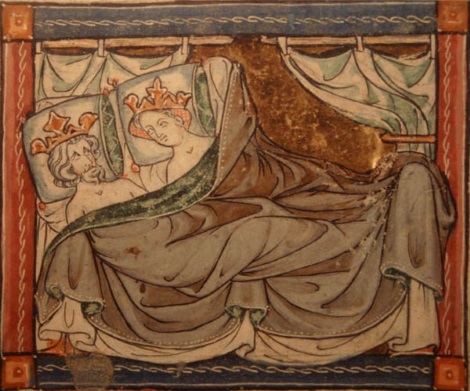 |
| Henry I of England & Nest ferch Rhys from a medieval manuscript @ British Library |
Also known as:
Nest ferch Rhys ap Tewdwr
Nest verch Rhys
Helen of Wales
Nesta of Wales
Princess of Deheubarth
the Helen of Wales: " . . . Nicknamed 'Helen of Wales' she was renowned for her beauty; like Helen of Troy, her good looks led to her abduction and civil war."
the Mother of the Irish Invasion: " . . . She is sometimes referred to as the 'mother of the Irish invasion' since her sons, by various fathers, and her grandsons were the leaders of the invasion. She had, in the course of her eventful life, two lovers, two husbands, and many sons and daughters. Her father is quoted as saying that she had 10 children as a result of her matrimonial escapades, eight sons and two daughters."
Daughter of: Rhys ap Tewdwr, King of Deheubarth & Gwladys ferch Rhiwallon ap Cynfyn of Powys.
Wife of:
"King Henry then married Nest off to Gerald de Windsor, an Anglo-Norman baron much older than his new wife. Gerald was Constable of Pembroke Castle and ruled Nest’s father’s former kingdom for the Normans. Marrying Nest to Gerald was a shrewd political move, lending the Norman baron some sense of legitimacy in the eyes of the local Welsh people." (Historic UK)
" . . . Nest was insufficiently high-born to be queen and was duly 'donated' to Gerald of Windsor, the king's governor in the strategically crucial province of Pembroke. It was a clever move. Maund points out that, as daughter of its former king, she would 'lend to a Norman lord some aura of legitimacy in the eyes of the Welsh ... a voice of some kind close to the centre of power'. Gerald built for her a new castle at Carew. Two of their children carried Norman names, William and Maurice, and two Welsh, David and Angharad." (The Guardian)
3. William Hait, Sheriff of Pembroke.
"Gerald died some time in the 1120s, and the widowed Nest appears to have accepted the comfort of the sheriff of Pembroke, a Flemish settler named William Hait. She delivered him a son, also William. . . ." (The Guardian)
4. Stephen de Mareis, Constable of Cardigan (c1075-1135)
" . . . But she was soon married to the Norman constable of Cardigan, Stephen, with yet another son, Robert Fitzstephen, and possibly two, born when she must have been in her 40s. Half of Wales must have Nest's genes in their blood." (The Guardian)
Natural offspring with Henry I of England:
1. Henry FitzHenry (c1103-1158)
"Princess Nest led an eventful life. She was born a princes’ daughter, became a king’s mistress and then a Norman’s wife; she was abducted by a Welsh prince and bore at least nine children to five different men." (Historic UK)
"As the daughter of the last king of South Wales, Nest was a valuable asset and taken as a hostage to William II’s court. Although only about 14 years old at the time, there her beauty caught the eye of Henry, William’s brother, later to become King Henry I. They became lovers; a medieval manuscript in the British Library shows them embracing, pictured naked except for their crowns." (Historic UK)
"The castellanship and lordship (not earldom) of Pembroke was initially awarded by Henry I (c.1102) to his own follower Saher, but this man proved unable to secure its safety . . . and by 1106 Henry restored Gerald of Windsor, whom he evidently decided to trust as a man with local experience. The latter went on to govern his precarious and isolated lordship successfully, balancing of Norman and Welsh lords against each other and importing Flemings to settle in Pembrokeshire in return for military service. . . As arranged by Henry, Gerald also became the new husband of Rhys ap Tewdr's daughter Nest, who had fallen into Norman hands after her father's death and was probably deported to England as 'spoils of war' or a hostage to her family's cooperation after the 1094 campaign. She then became one of King Henry's many mistresses, probably before his accession in 1100 and bore him a son, Henry (d.1158). . . [S]he was married to Gerald by Henry and returned to wales as lady of Pembroke Castle. They produced a large and famous family, from whom the Fitzgerald dynasties of Ireland (earls of Kildare and Desmond) descended. . . ." (Kingmakers: How Power in England Was Won and Lost on the Welsh Frontier: 1116)
"[I]n 1093, Rhys of Deheubarth was killed in battle outside Brecon. south Wales was overrun by Normans, and Nest, her mother and brothers were seized as hostages. The princess was probably no more than 12 at the time. As the virgin daughter of the last reigning king of wales, she was a valuable asset in the murky world of Anglo-Celtic politics. Accustomed to the ways of Wales and familiar only with Irish and Vikings over the seas, she must have been terrified by William's rough and ruthless barons. Yet she was lovely enough to be taken into William II's court and catch the eye of Henry, his shrewd but lustful brother. A man whose womanising was noted even by medieval chroniclers, Henry was a dashing figure who had fathered some 20 illegitimate children by the time of his marriage and coronation as Henry I in 1100. His coupling with Nest, naked apart from their crowns, is the first depiction of such a relationship, in a medieval manuscript now in the British Library. The result was Henry FitzHenry. The Welsh girl was clearly a fixture at the Norman court." (The Guardian)
"Gerald, it is claimed was a great favourite of the King, his wife even more so, which was perhaps why Gerald was made Baron of Moulsford in Berkshire for services rendered by Nesta? Nesta is fascinating. She was said to have been the most beautiful woman in Wales. Without a portrait we have only her reputation to go on. She was certainly popular, if not notorious, bearing between 11-13 children, half of them illegitimate, to six different fathers. Mistress to the Henry and married to Gerald, Nesta seemed to find it difficult to say no to her many admirers. To Henry I, Nesta appears to have had one son, Henry (born 1115) who was killed by the Welsh at Anglesey in 1157 while supporting a campaign by his nephew, Henry II." (Barons, Rebels and Romantics: The Fitzgeralds' First Thousand Years: xiii-xiv)
7) Sibyl Corbet, Lady of Alcester (1075-1157)
Daughter of: Sir Robert Corbet.
Wife of: Herbert FitzHerbert, son of Herbert the Chamberlain, & Emma de Blois.


